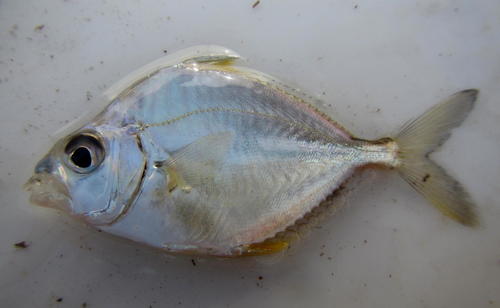
About Leiognathus equulus (Forsskål, 1775)
Ponyfishes as a group are characterized by highly protractile mouths that can extend ventrorostrally, rostrally, and dorsorostrally. The common ponyfish (Leiognathus equulus) is one of the largest species in the Leiognathidae family. Adult common ponyfish reach total lengths between 150 millimetres (5.9 in) and 240 millimetres (9.4 in), and weigh 60 to 200 grams. Females have a higher average total length and body weight than males. Most females have a fork length of 130–200 millimetres (5.1–7.9 in) and a weight of 60–200 grams (2.1–7.1 oz), while most males have a fork length of 130–190 millimetres and a weight of 60–180 grams (2.1–6.3 oz). Reported sizes for this species vary across regions, which suggests geographic factors such as fishing frequency and local food availability impact adult fish size. Common ponyfish have deep, laterally compressed bodies with a rhombus-like shape. Their bodies are covered in cycloid scales, though their heads are scaleless. Their base body color is usually a light silvery-grey, with some darker grey or brown patches, most notably a band across the lateral line and back, or on the caudal peduncle. Their fins may also have some yellow coloration. The lightly curved lateral line is composed of 63 to 70 pored scales. They have one dorsal fin with 8 spines and 16 rays, and an anal fin with 3 spines and 14 rays. Both the dorsal and anal fins have membranous sheaths covering their bases, and the second spine is the longest of the spines on each fin. Their pectoral fins and subthoracic ventral fins are rounded, with the pectoral fins being longer and wider than the ventral fins. The caudal fin is forked with rounded tips. In juvenile fish, the terminal ventral fin extends to the origin of the anal fin. Common ponyfish have a shortened snout, a small slightly downward-facing terminal mouth, and a concave jaw. Inside the mouth, 3 to 4 rows of pointed, bristled teeth curve inward. They have somewhat large eyes with an underdeveloped adipose eyelid. This species also has a 'fin lock' mechanism, plus preorbital spines with serrated ridges. It is hard to tell male and female L. equulus apart by external appearance alone, like with many other leiognathid species. The most reliable way to distinguish sexes uses the circumesophageal light organ that all leiognathids possess, which shows strong sexual dimorphism in common ponyfish. In males, this light-producing organ is larger, and has extra structures that support photic communication for sexual displays. The common ponyfish is a tropical and subtropical bottom-dwelling species that lives in coastal waters, river estuaries, fresh water, brackish water, and benthopelagic environments. It is most commonly found in marine waters at depths between 10 and 200 metres (33–656 ft). It has a wide distribution across the Red Sea, Persian Gulf, and Indo-West Pacific Ocean. Its range also includes the coastal regions of Taiwan and the Taiwan Strait, southern Japan, the Ryukyu Islands, parts of the Nansha Islands, Hainan Island, Guangdong, Beibu Gulf, Guangxi, the east coast of Africa, Queensland (Australia), New Caledonia, and the Mariana, Caroline, and Samoan islands. In southern Taiwan, common ponyfish spawn between May and August, though spawning timing differs in other regions. In Queensland, Australia, many small individuals measuring 7.5–82.5 millimetres (0.30–3.25 in) are found in mangrove estuaries from December to February, leading to the conclusion that larvae inhabit estuarine areas. Sex ratios vary by season: more males are observed from March to May, while more females are observed from June to February. The proportion of males increases with body size, which may be linked to a higher mortality rate in males, as females tend to live longer. Females generally reach sexual maturity earlier than males, but this pattern can vary by location, likely due to differing environmental conditions. Oocyte development in common ponyfish occurs in eight distinct stages. In the chromating-nucleolus stage, oocytes are very small, with large nuclei surrounded by a thin layer of cytoplasm. In the peri-nucleolus stage, oocyte volume increases and the nucleus-to-cytoplasm ratio decreases. Next comes the yolk vesicle stage, followed by the primary yolk stage, where yolk globules and vesicles grow in number and size. In the secondary yolk stage, yolk globules and vesicles grow rapidly in both number and size. In the tertiary yolk stage, oocytes increase further in size and yolk globules begin to merge into a yolk mass. In the migratory nucleus stage, the yolk forms a homogeneous mass and the nucleus moves toward the animal pole of the egg. In the final ripe stage, the nuclear membrane disappears and the egg becomes translucent and white.

