About Leiocephalus personatus (Cope, 1863)
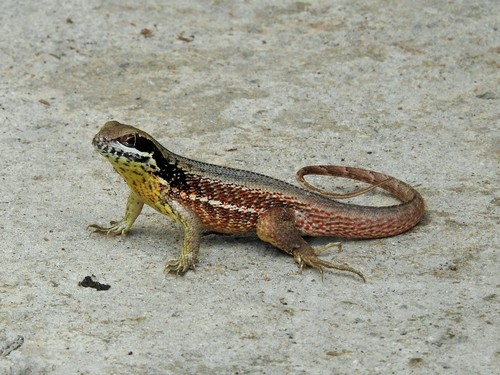
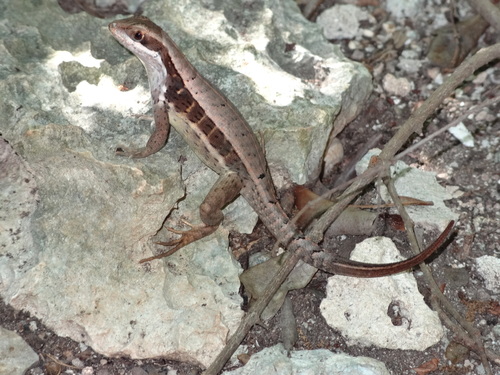
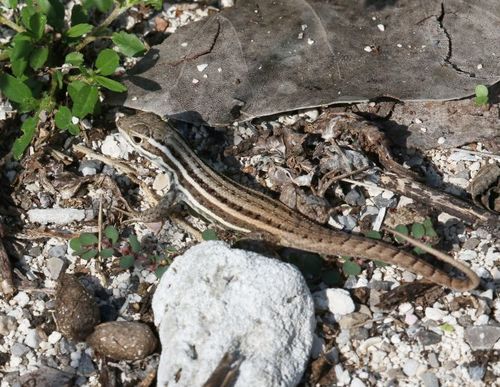
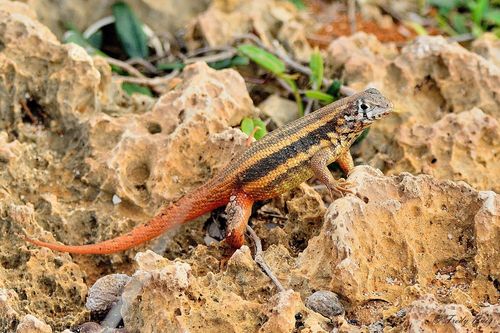
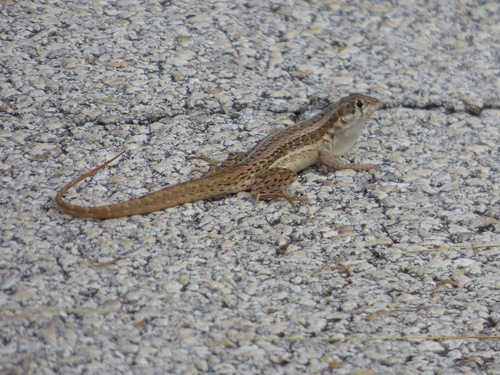
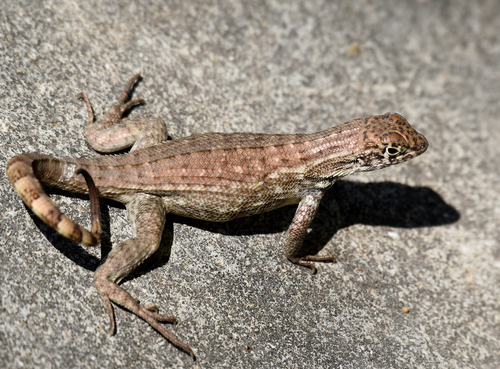
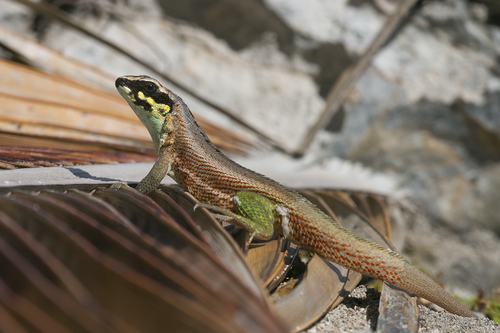
Leiocephalus personatus (Cope, 1863) is a sexually dimorphic lizard species. Males are considerably larger than females: males measure 72 mm (2.8 in) in snout–vent length, with a 122 mm (4.8 in) tail, while females have a snout-to-vent length of 54 mm (2.1 in). Males have red markings on the head around the lower jaw, a black face and throat that extends past the ear to the shoulder folds, and a brown crown. Young males often have pale spots below and in front of their ears. Older males frequently have a wide pale longitudinal stripe on the back as well as lateral stripes. Their underparts, including the chin, legs, and their paler tail, are lightly spotted with black. Females are much smaller, brown in color, with lighter stripes running down the flanks. Females are more drab in overall coloration, with four pale longitudinal stripes, heavy black barring between the stripes, and underparts that are heavily spotted with black. This lizard is endemic to Hispaniola in the Caribbean Sea, where it occurs across multiple locations in Haiti and the Dominican Republic, at altitudes up to approximately 625 m (2,000 ft). It primarily inhabits damp locations, but also occurs in shaded areas of dry shrubland, including broadleaf woodland, pine forests, plantations, coastal scrub, gardens, arable land, and pasture. It can also be found in urban areas, city parks, and town gardens. In 1994, this species was first recorded in Florida, where it was noted as a newly arrived exotic species likely to colonize natural areas; in Florida, it is restricted to several localities in Dade County. Leiocephalus personatus is ground-dwelling and diurnal. It feeds mainly on insects and other small arthropods, and also consumes some plant material. It is likely preyed on by the introduced invasive small Indian mongoose (Urva auropunctata) on Hispaniola. A study of the species' anti-predator behavior found that lizards living in more open, exposed locations tend to have traits such as longer limbs and faster sprint speeds.