About Lecidea tessellata Flörke
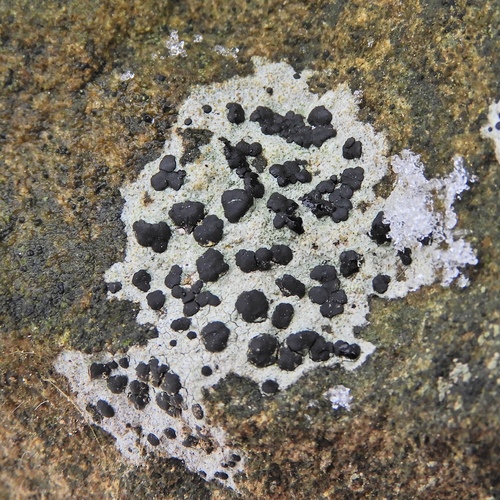
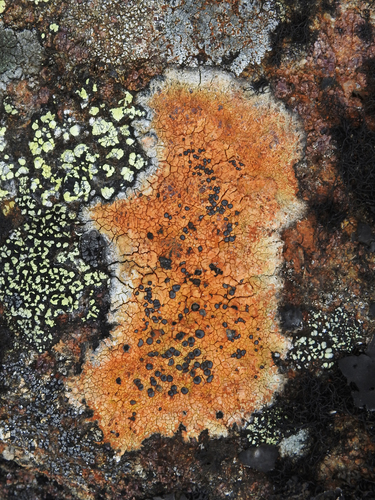
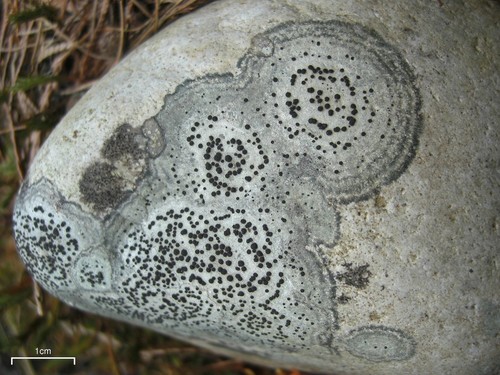
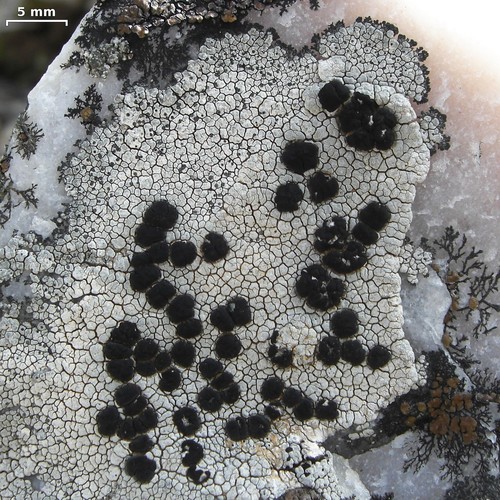
Lecidea tessellata Flörke has a chalky white to grey, cracked, areolate thallus. Its apothecia are black, subimmersed, appressed to adnate, and range from 0.5 to 1.8 (up to 2.0) mm in diameter. The apothecial disc is smooth; it is initially rounded on young apothecia, becoming convex and irregular on mature apothecia, and sometimes has a thin white pruinose layer. The epihymenium is brownish-green to blackish-green, while the hymenium is colorless and measures 40–60 μm in height. The hypothecium is pale brown and measures 30–40 μm in height, and the excipulum is blackish-green on the outside and colorless internally. The asci are clavate, measuring 30–50 by 8–14 μm, and the ascospores are ellipsoid, measuring 7–9 by 5–6 μm. This lichen contains confluentic acid, a lichen product that can be detected with thin-layer chromatography. Both the thallus and medulla of L. tessellata give negative reactions to all standard chemical spot tests (K−, C−, PD−). Lecidea oreophila, a species found in the mountainous Sierra Nevada region of California, is similar in outward appearance to L. tessellata, but differs by having a dark hypothecium and producing 2′-O-methylmicrophyllinic acid as its primary lichen product, which may occur with or without accessory confluentic acid.