About Lecidea fuscoatra (L.) Ach.
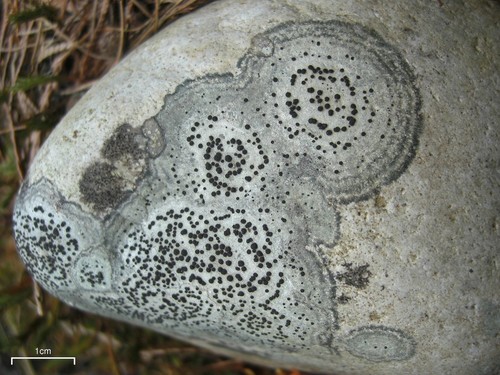
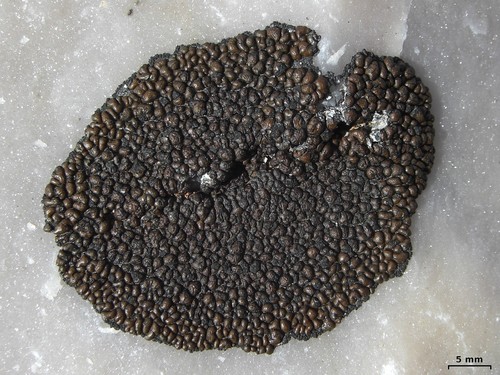
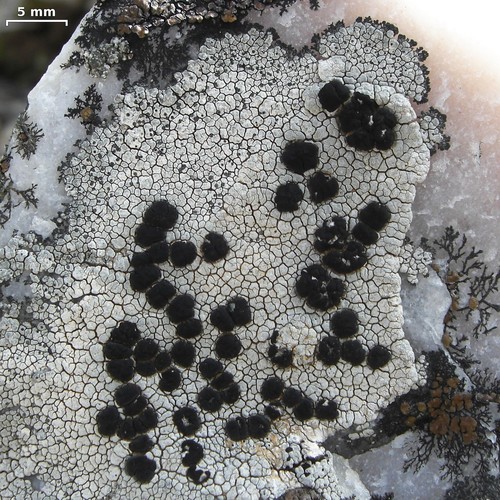
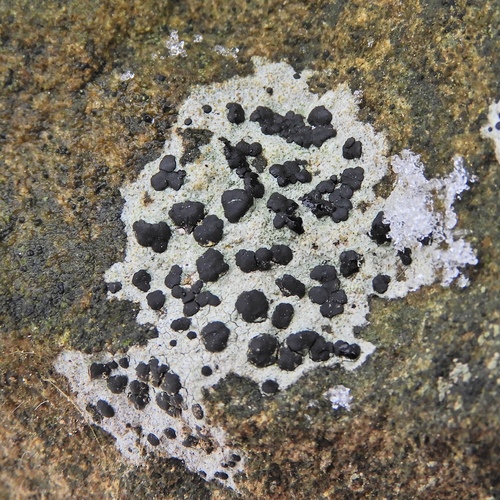
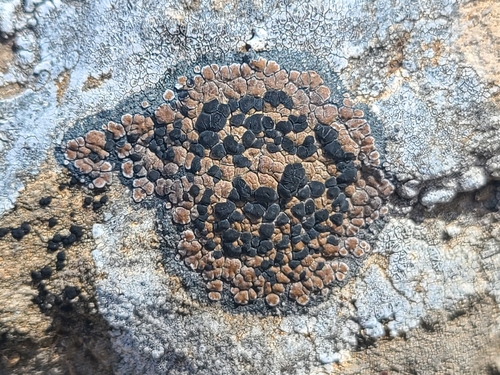
Lecidea fuscoatra (L.) Ach. forms a thin crust that breaks into many small, tile-like patches, which is an areolate thallus. The surface is shiny and ranges in colour from whitish grey to pale yellow-brown or grey-brown; each patch is usually up to about 3 mm across, and is flat to slightly rounded. A black border of fungal tissue called the prothallus may outline the patches. Just above the pigmented outer skin lies a thin layer of dead, colourless cells, which is an epinecral layer, and the inner white medulla layer does not turn blue when exposed to iodine. Its fruiting bodies are small black discs called apothecia, 0.5–2 (up to 3) mm wide, that are typically sunk into, or seated between, the thallus patches. These apothecia are flat to slightly domed and may be dusted with a grey frost called pruina. The disc retains a slightly raised, persistent rim called the true exciple. Under a microscope, this rim is constructed from chains of rounded cells that are brown on the outside and colourless within, and it produces a pink reaction in the C spot test. The uppermost film on the disc, called the epithecium, is olive-green to olive-brown and becomes more olivaceous when exposed to KOH. The spore-bearing layer, the hymenium, is 40–60 μm tall, and the tissue beneath it, the hypothecium, is dark brown to black and often forms a short, stalk-like base. The supporting threads called paraphyses are mostly unbranched, 1.5–2 μm thick, with tips reaching 3 (up to 5) μm that may be tinged olive-brown. The spore sacs, called asci, measure 45–55 × 8–15 μm and contain eight spores each. The ascospores are colourless, ellipsoid to narrowly ellipsoid, and usually measure 11–16.5 × 4.5–6.5 μm. Asexual spores, conidia, are very slender rods, typically measuring 7–10 × 0.5–0.8 μm. In standard spot tests on the thallus, C (bleach) gives a positive red reaction, while K (potassium hydroxide), KC, Pd (para-phenylenediamine), and UV tests are all negative. These reaction results indicate the presence of gyrophoric acid, sometimes with a small amount of lecanoric acid. The depside compound 2-O-methylconfluentinic acid was first identified from L. fuscoatra. Lecidea fuscoatra is widespread, with reported occurrences in Europe, North Africa, North America, and Asia. Within Europe, it is more frequent on natural, generally acidic rocks such as granite and sandstone, and is relatively common in boreal regions. It has also been recorded growing on hornfels in the Sudety Mountains of Poland. In Galicia, north-west Spain, L. fuscoatra has been recorded on granite church masonry exposed to marine aerosols, for example at the Church of Santa María das Areas in Fisterra, where it occurs on both vertical apse walls and horizontal structural elements. This record shows that the species readily colonises worked stone in coastal settings.