About Leccinum scabrum (Bull.) Gray
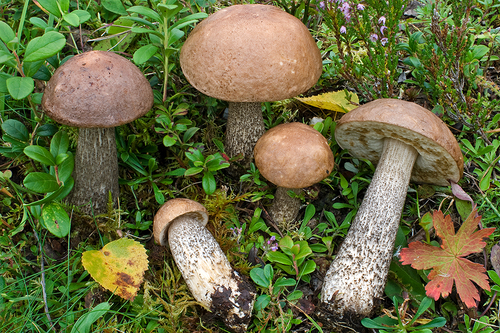
The cap of Leccinum scabrum measures 4–10 cm (1+1⁄2–4 in) across; it starts convex and flattens as it matures. The cap skin is tan or brownish, usually with a paler edge, and has a smooth, hairless texture that ranges from dry to viscid. The pores are whitish when young, and turn gray with age. In older fruiting bodies, the pores on the cap bulge outwards, while the pores surrounding the stalk indent deeply. The pore layer can be easily separated from the cap skin. This species produces a brown spore print. Its spores are elliptical, measuring 13–16 by 4–4.5 μm. The stipe (stalk) is 5–15 cm (2–6 in) long and 1–3.5 cm (3⁄8–1+3⁄8 in) wide, slender, and tapers toward the top; it is white with dark to black flaky scales. The base mycelium is white. The flesh is whitish, and sometimes darkens when exposed to air. In young specimens, the flesh is relatively firm, but it quickly becomes spongy and retains water, especially during rainy weather. The flesh turns black when cooked. Leccinum scabrum is native to Europe, and has been introduced to many other regions across the globe, where it occurs mostly in urban areas. It always grows in association with birch trees. In its introduced range, it has been found growing with ornamental birch planted outside its native area, including in California. In New Zealand, it associates only with Betula pendula. In North America, it can be found from June to September across most of the continent; on the West Coast, it appears instead from September to November.