About Leccinum manzanitae Thiers
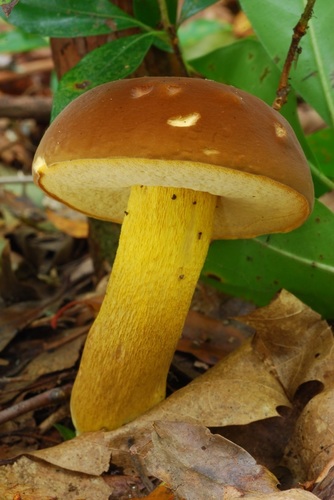
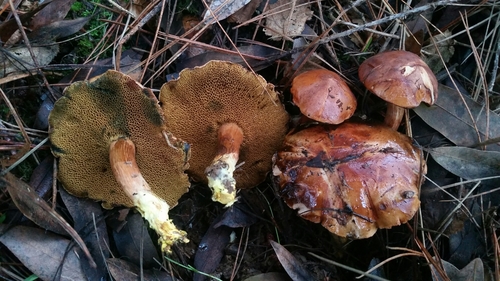
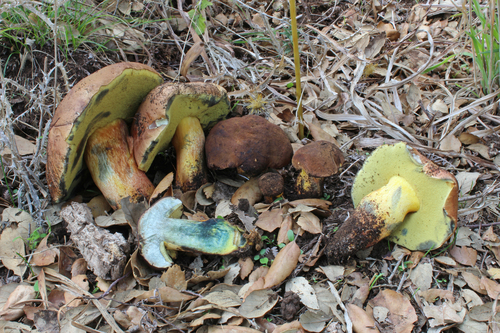
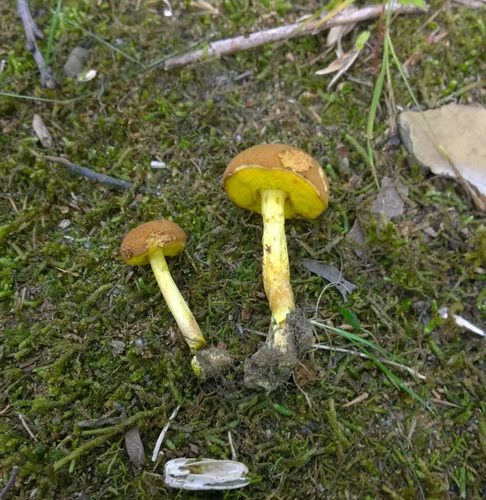
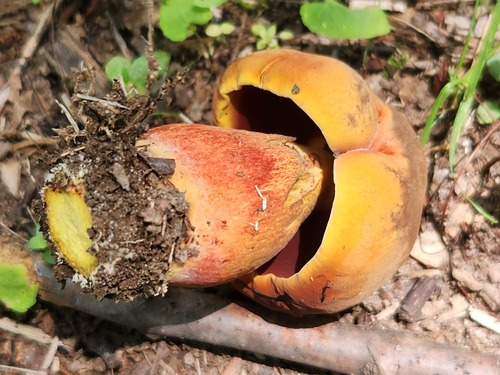
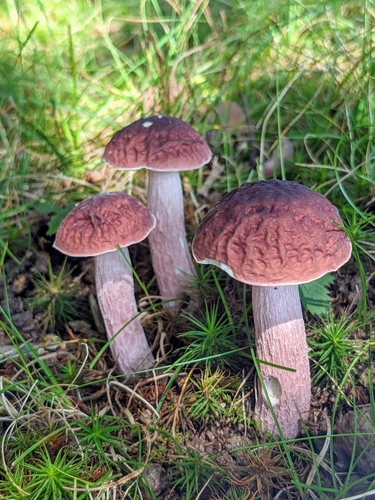
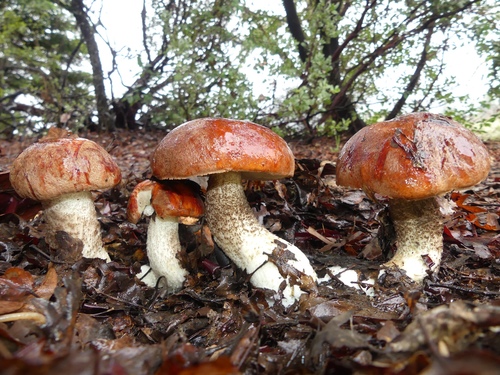
Leccinum manzanitae Thiers can produce sometimes massive fruit bodies that occasionally reach weights of several pounds. The cap measures 7–20 cm (2.8–7.9 in) in diameter; it is spherical to convex when young, becoming broadly convex to flattened or cushion-shaped (pulvinate) as it matures. The cap surface is often shallowly to deeply pitted or reticulate, sticky, and covered with pressed-down hairs that are more visible toward the cap edge, and remains dark red through all stages of development. The cap flesh is 2–4 cm (0.8–1.6 in) thick; it is white when first cut or exposed, then slowly and irregularly changes to dark brownish-gray with no intermediate reddish stage. This color change after bruising or injury is often more noticeable in young specimens. The tubes that make up the hymenophore are 1–2.5 cm (0.5–1 in) long, attach to the stipe in an adnate arrangement, are pale olive when young, and darken when bruised. The pores are up to 1 mm in diameter, angular, and match the tube color. The stipe measures 8–18 cm (3–7 in) long and 1.5–4 cm (0.6–1.6 in) thick at the apex, and is either club-shaped or swollen in the middle. It is solid (not hollow), has a dry surface, and is covered in small, stiff, granular projections called scabers. Scabers are typically whitish when young, and eventually darken to dark brownish-gray as the mushroom ages. The stipe flesh stains blue when bruised, though this reaction varies between specimens and is sometimes slow to appear. Leccinum manzanitae has no distinctive taste or odor, and produces a cinnamon-brown spore print. Spores measure 13–17 by 4–5.5 μm, are somewhat elliptical to cylindrical, tapered at both ends (fusoid), with smooth, moderately thick walls. The spore-bearing cells (basidia) are 27–32 by 6–9 μm, club-shaped to pear-shaped (pyriform), and four-spored. Cystidia are 23–32 by 4–6 μm, fusoid to club-shaped with narrow, elongated apices. Caulocystidia (found on the stipe surface) are thin-walled, club-shaped to somewhat fusoid, sometimes ending in a sharp point, and measure 35–45 by 9–14 μm. Clamp connections are absent in the hyphae of Leccinum manzanitae. The hyphae of the cap cuticle form a trichoderm, where the outermost hyphae emerge roughly parallel to each other, perpendicular to the cap surface. Several chemical tests can help confirm identification of the species: a drop of dilute 3–10% potassium hydroxide (KOH) solution turns the tubes pale red; nitric acid (HNO3) applied to the tubes produces an orange-yellow color; a solution of Iron(II) sulfate (FeSO4) applied to the flesh produces a pale grey color. Thiers also described the variety L. manzanitae var. angustisporae from Mendocino County. This variety is similar to the main species in appearance and habitat, but has smaller, narrowly elongated spores that typically measure 3–4 μm wide and 1–2 μm longer than the main form. Leccinum manzanitae is a mycorrhizal species. Its fruit bodies grow singly to scattered in soil under madrone and manzanita. It is known to occur only in North America; it is commonly found from central California to southern Oregon, and has also been reported further north in Washington and British Columbia, Canada. Thiers considered it the most abundant Leccinum species in California, and it can be found from October to February.