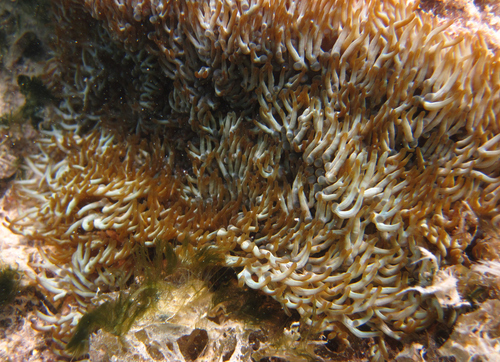
About Lebrunia neglecta Duchassaing & Michelotti, 1860
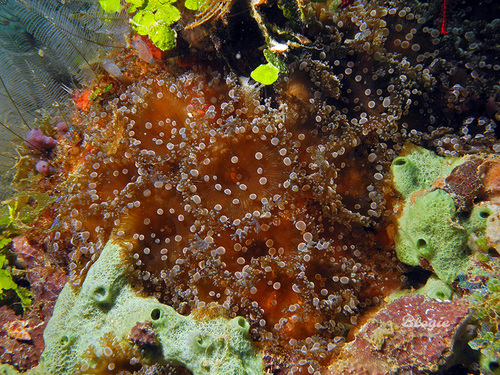
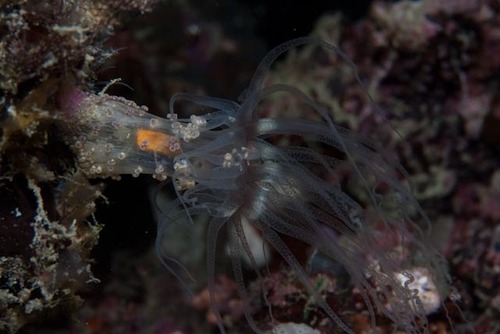
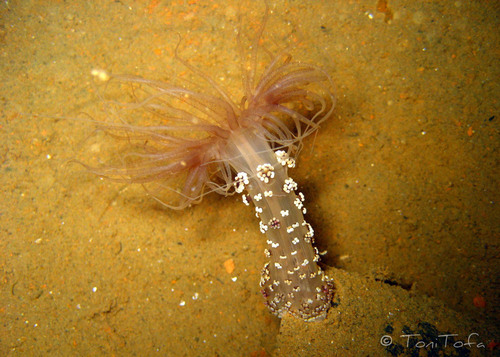
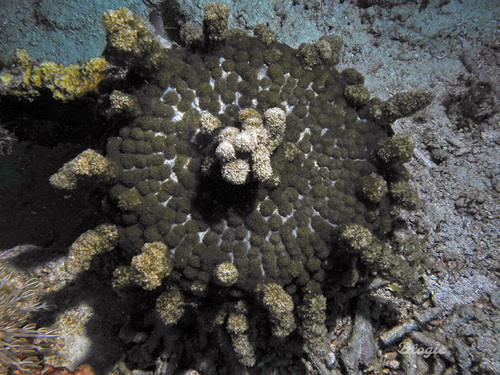
Lebrunia neglecta is an unusual species of sea anemone. Its true tentacles are almost completely hidden by a ring of six large, much-branched, frond-like pseudotentacles that grow from the rim of its oral disc. The pseudotentacles are some shade of pale to darker brown, and have densely branched tips. Small, whitish spherical vesicles containing powerful nematocysts capable of stinging humans grow on the sides of these fronds, below their tips. When a prey item makes contact with the pseudotentacles, the pseudotentacles retract. The true tentacles, which are also armed with nematocysts, then grasp the prey and pull it into the anemone's mouth. The column of this anemone is usually not visible, as it is anchored inside a crevice. This species can grow to a diameter of 20 cm (8 in). It is very similar in appearance to its close relative Lebrunia coralligens, but L. coralligens has much less branched pseudotentacles that often have swollen, double-lobed tips. Lebrunia neglecta is distributed in Bermuda, the Bahamas, the Caribbean Sea, the Gulf of Mexico, and along the north coast of Brazil. It inhabits reef environments at depths between 2 and 60 metres (6 to 200 feet), with its column hidden inside a crevice in rock or within a massive coral head. The tissues of Lebrunia neglecta host Symbiodinium, a symbiotic unicellular alga. This alga is photosynthetic and provides the anemone with energy. The pseudotentacles of Lebrunia neglecta resemble the fronds of brown algae in the family Dictyotaceae, and it is possible that the anemone mimics this harmless alga to lure potential prey closer. The pseudotentacles retract at dusk. A number of different invertebrates form close associations with Lebrunia neglecta. These associated species include Pederson's cleaning shrimp (Ancylomenes pedersoni), the spotted cleaner shrimp (Periclimenes yucatanicus), the shrimp Periclimenes rathbunae, the shrimp Thor amboinensis, the arrow crab Stenorhynchus seticornis, the anemone crab Mithraculus cinctimanus, and a brittle star. These associated animals receive protection from the anemone's nematocysts, and are found either among the anemone's pseudotentacles or in their own characteristic locations close to the anemone.