About Layia platyglossa (Fisch. & C.A.Mey.) A.Gray
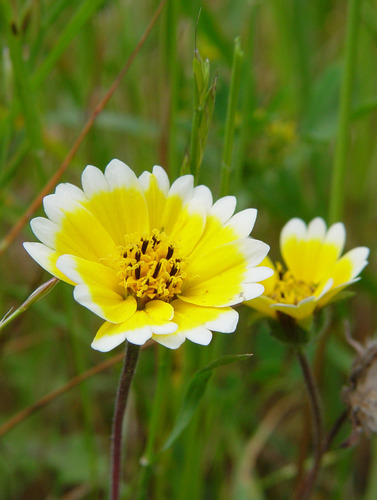
Layia platyglossa, commonly called tidytips, is an annual, glandular, daisy-like plant. It grows under 1 foot (0.30 m) tall, and typically reaches 4–12 inches (10–30 cm) wide. Its roots are usually taproots, and sometimes fibrous. Leaves are arranged alternately or oppositely; leaf blades are usually simple, and rarely compound. Upper stem leaves are short, rough and hairy, with a pilous texture, and have smooth entire edges. Basal and lower stem leaves are generally lobed, ranging from toothed (dentate) to pinnate, with rounded short lobes. The plant produces indeterminate zygomorphic inflorescences, with individual flower heads borne on a peduncle. Stems are most often erect, but can also be prostrate, decumbent, or ascending; they are stout and corymbed branched. Each flower head holds 5 to 18 yellow ray flowers with white tips, surrounding many central yellow disk flowers. The outer ray flowers are bright golden yellow with clear, sharply defined white tips. The tips of the inflorescence bracts are rounded, and the involucre measures 6–12 mm high. The corolla is 4–6 mm long; ray flowers are 3–3.8 mm long, while disk flowers are 2.8–5 mm long. The ligules measure 6–15 mm long and 5–10 mm wide. Florets can be bisexual, pistillate, functionally staminate, or neuter, and sepals are highly modified. Insects carry out pollination for this species. Fruits are usually dry with thick, tough pericarps, and are sometimes beaked (rostrate) and/or winged. Fruit dispersal is done by wind with assistance from the plant’s pappus. Each fruit contains one seed, with a straight embryo. Tidytips was formerly found across all low-elevation dry habitats in California, including the Mojave Desert, and extended north into Arizona and Utah. In pre-European times, this plant was common in large solid stands at lower elevations. It grows in grassy valley floors, hillsides, openings in coastal sage scrub and chaparral, coastal plains, and the High Desert. It is a member of spring wildflower displays, and blooms from March to June. This species is also found in Mexico, in the state of Baja California, where it is common from Tijuana south to the Sierra de La Asamblea in central Baja California. It also grows on Guadalupe Island in the Pacific Ocean. Layia platyglossa is cultivated as an ornamental plant, and is often included as an ingredient in commercial wildflower seed mixes. Its attractive daisy-like flowers make it a popular annual flower for traditional gardens, wildlife gardens, and habitat gardens. This wildflower is also used in habitat restoration projects. It supports pollinators, and its ripe seeds serve as a food source for birds.