About Lavinia exilicauda Baird & Girard, 1854
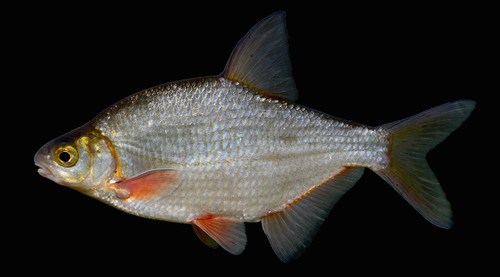
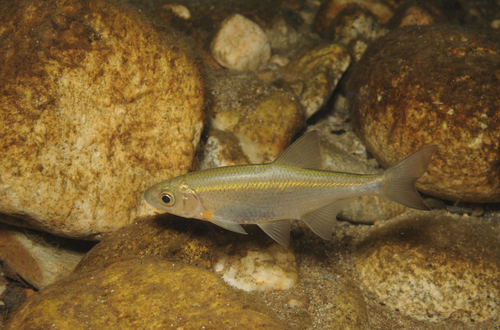
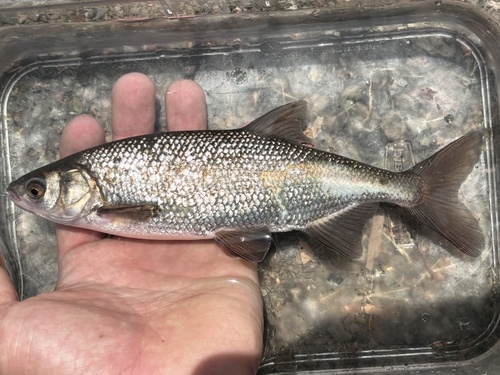
Lavinia exilicauda (Baird & Girard, 1854), commonly called the hitch, has a deep, laterally compressed body, a small head, and an upward-pointing terminal mouth. Its body is generally solid silver overall; juvenile individuals have a black spot at the base of the tail, which they lose as they age, and adults also become generally darker as they grow. Its anal fin, which has 11 to 14 rays, is noticeably longer than that of other California minnows. Its dorsal fin has 10 to 13 rays, is positioned further back on the body, with its base located between the pelvic and anal fins. Its tail fin is large and deeply forked. This species can reach a relatively large size for a minnow, growing up to 36 centimetres (14 inches) in total length. All of these physical characteristics give it a strong resemblance to the golden shiner. The hitch is closely related to the California roach (Hesperoleucus symmetricus complex), and these two taxa can hybridize with one another. Hitch are open-water omnivores, feeding on a mixture of filamentous algae, insects, and zooplankton. They inhabit lakes, sloughs, and slow-moving sections of rivers and streams. They have the highest temperature tolerance among native fish of California’s Central Valley, so they can live in both warm and cool water. They also have considerable salt tolerance: for example, they occur in Suisun Marsh, which has a salinity of 7 to 8 parts per thousand, and in the Salinas River lagoon, which has a salinity of 9 parts per thousand. The natural range of Lavinia exilicauda includes the Sacramento River–San Joaquin River System of the Central Valley, the Russian River, Clear Lake, the Pajaro River, and the Salinas River. While the species was once abundant, and was historically commercially fished in Clear Lake, it is no longer fished commercially there, and overall populations of Lavinia exilicauda have been declining. The most likely cause of this decline is loss of springtime spawning water flows due to human water diversion and damming.