About Lavandula viridis L'Hér.
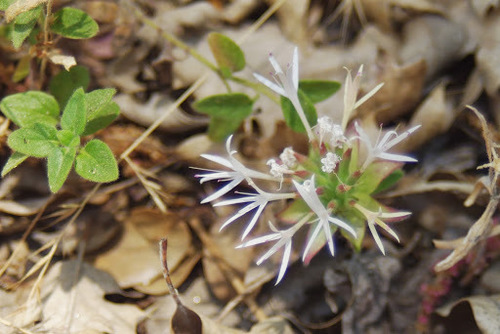
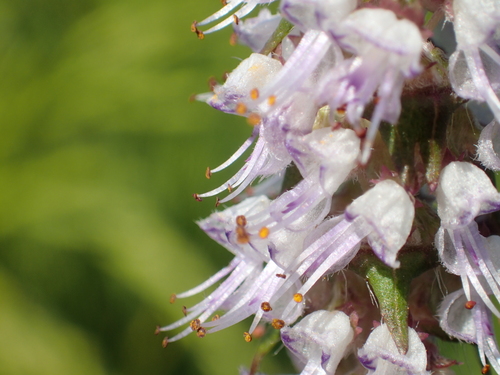
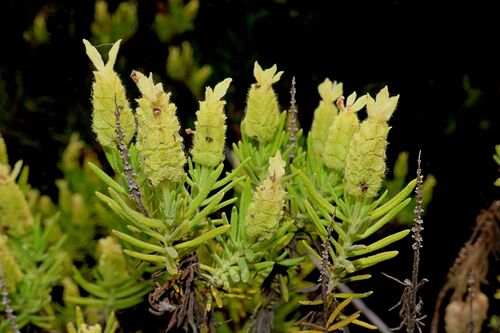
Lavandula viridis L'Hér. is a sticky, strongly aromatic shrub with woody tissue at its base and leafy growth toward its top. Mature plants average 50 to 70 cm tall, and can occasionally reach 100 cm in height. Its small flowers start white and quickly turn brown. Its leaves attach directly to the stem, measure approximately 2.5–4 cm by 0.3–0.5 cm, have a linear shape, and taper to a blunt tip. Small, highly branched hairs cover both the leaves and flowering sections of the plant, which creates its sticky texture. Its peduncles, measuring approximately 5–10 cm long, are unbranched and covered in the same type of highly branched hairs. Bracts are also covered in these hairs; they are fertile, greenish-white, with a rounded apex and a narrow base. The calyx is approximately 0.8–1 cm long and has four triangular lobes. The corolla is tubular with a wider upper section, and is typically around 1.5 times as long as the calyx. The pollen of L. viridis is orange. L. viridis is endemic to the southwestern Iberian Peninsula, specifically southern Portugal’s Algarve and Baixo Alentejo regions and southwest Spain’s Huelva and Seville regions. It commonly grows in dry conditions and nutrient-poor soils, requiring very little water to survive. It thrives in warm climates, and grows well in parts of Australia, New Zealand, and the southern United States. It can also be found in low-altitude coastal regions of the Mediterranean, and has been introduced to the Azores and Madeira. The white color of its flowers attracts night-flying insect pollinators such as moths, while the plant’s strong, lemon-like scent attracts bees during the day. L. viridis has been used for medicinal purposes, because its tissues contain a high concentration of essential oils. One study identified 51 different essential oil compounds in this species, most of which were found in actively growing shoots. The oils contain a large proportion of oxygen-containing monoterpenes, followed by monoterpene hydrocarbons. Among the 51 compounds, 1,8-cineole, camphor, alpha-pinene, and linalool had the highest percentages, in that order. Experimentation found that these oils have antifungal activity against yeasts and filamentous fungi, specifically strains of Candida, Aspergillus, Trichophyton, Epidermophyton, and Cryptococcus. Among these tested strains, L. viridis oil was most active against Cryptococcus, followed by Candida, and was least effective against Aspergillus strains.