About Laurus novocanariensis Rivas Mart., Lousã, Fern.Prieto, E.Días, J.C.Costa & C.Aguiar
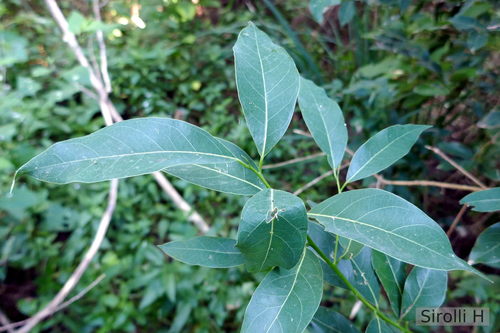
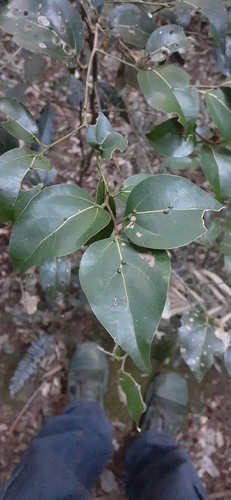
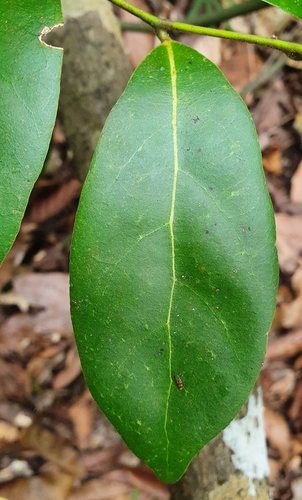
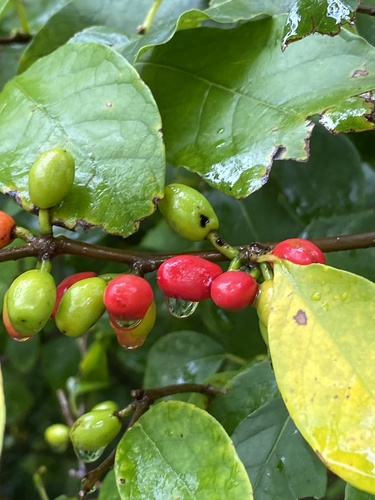
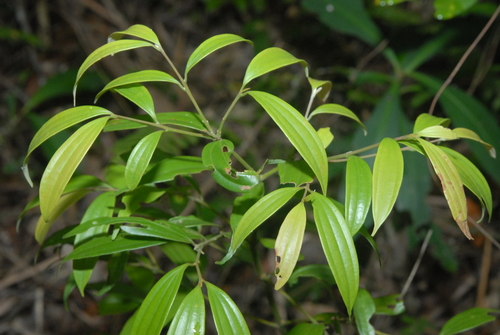
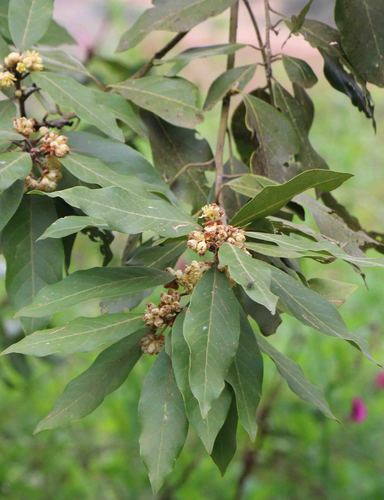
Laurus novocanariensis is a dioecious (unisexual) laurel species, with male and female flowers growing on separate individual plants. In local naming, female plants are called laurel, while male plants are called loro. It is a tree with a relatively dense canopy, growing 6 to 20 meters tall. It can be identified by its lanceolate leaves, which have small glands located in the angle between the central vein and lateral veins. Leaves are 5 to 17 cm long, petiolate, and grow in an alternate arrangement. Leaf shapes vary between ovate, elliptic, oblong, and lanceolate; they are leathery, deep green, and glossy, with glossiness more prominent on the upper surface than the underside. Leaves of this species have a much finer, very delicate aroma, unlike the strongly scented leaves of Laurus nobilis. Its flowers are small, roughly 1 cm in diameter, unisexual, yellowish-white, fragrant, and arranged in axillary clusters that grow in pairs beside a leaf. Flowering occurs from November to April. The fruit is an ovoid, olive-like berry that measures 1–1.5 cm long, holds one seed per fruit, and turns black when mature. This species is easily cultivated in any humus-rich, well-drained soil, placed in a spot that gets sun during winter and partial shade during summer. Plants should be kept slightly drier in winter, with a minimum temperature of around 5 °C. To propagate, sow the small avocado-like seeds in any humus-rich, slightly moist soil, and keep the soil at around 20 °C. Germination begins after 4 to 6 weeks. In winter, keep seedlings cooler but frost-free, with reduced watering, in a sunny location. Galls caused by the fungus Laurobasidium lauri, also known as Madrelouro, are commonly found on the trunks of this species. Laurus novocanariensis is a species characteristic of Macaronesia's laurisilva forests, and is native only to the archipelagos of Madeira and the western and central Canary Islands. It is commonly associated with Apollonias barbujana and Ocotea foetens. Before 2004, this species was considered the same species as the endangered Laurus azorica. Though it is closely related to the Azorean species, it has significant genetic, morphological, and physiological differences from Laurus azorica.