About Laurus nobilis L.
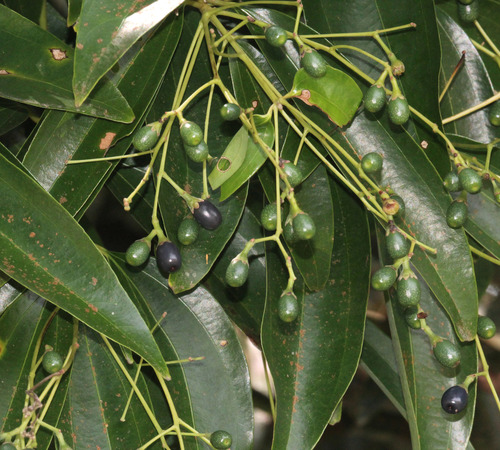
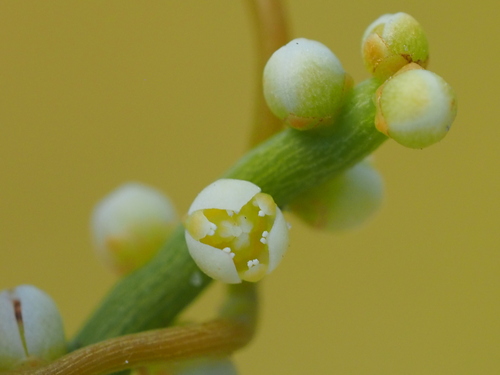
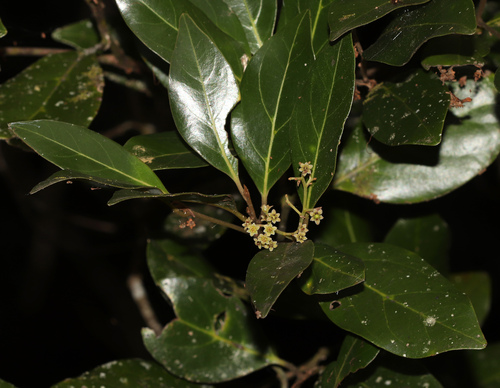
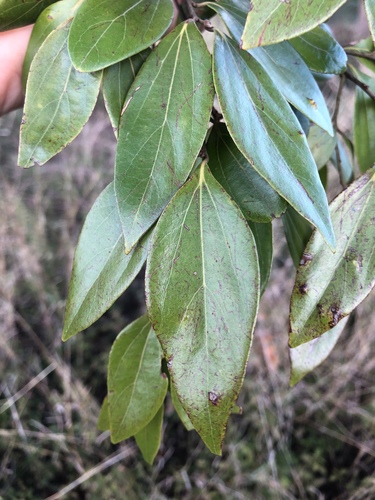
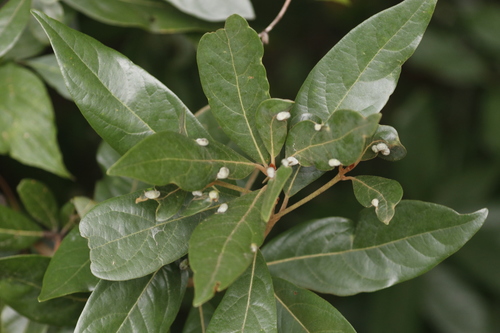
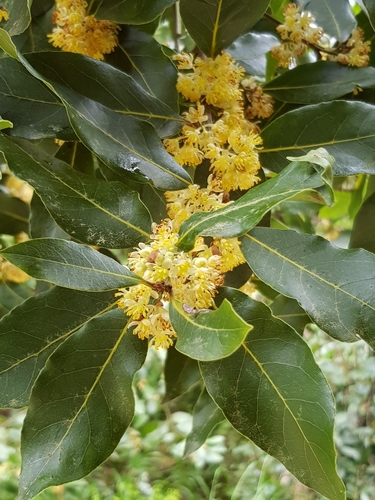
Bay laurel, known by the scientific name Laurus nobilis L., is an evergreen shrub or small tree. It varies in size, and can sometimes grow 7–18 m (23–59 ft) tall. The genus Laurus contains three accepted species, whose identifying key characteristics often overlap. Bay laurel is dioecious, or unisexual, meaning male and female flowers grow on separate individual plants. Each flower is pale yellow-green, around 1 cm (3⁄8 in) in diameter, and grows in pairs beside a leaf. The leaves are glabrous, 6–12 cm (2–5 in) long and 2–4 cm (3⁄4–1+5⁄8 in) wide, with a smooth untoothed (entire) margin. Some leaves have a wavy, undulating margin. Its fruit is a small, shiny black drupe-like berry about 1 cm (3⁄8 in) long that holds one seed. Laurus nobilis is a widespread relict of the laurel forests that once covered most of the Mediterranean Basin when the region's climate was more humid. As the Mediterranean climate dried out during the Pliocene era, laurel forests gradually retreated, and were replaced by the more drought-tolerant sclerophyll plant communities that are common in the region today. Most of the last remaining Mediterranean laurel forests are thought to have disappeared roughly 10,000 years ago, though small remnant populations still persist in the mountains of southern Turkey, northern Syria, southern Spain, north-central Portugal, northern Morocco, the Canary Islands, and Madeira. This plant is the source of several popular herbs and one spice used in a wide range of recipes, especially in Mediterranean cuisines. Bay leaves are typically removed from dishes before serving, though they may also be used as a simple garnish. Whole bay leaves have a shelf life of around one year under normal temperature and humidity conditions. Whole bay leaves are used almost only as a flavoring agent during food preparation. Ground bay leaves, by contrast, can be eaten safely and are often added to soups and stocks, and are a common ingredient in a Bloody Mary. Dried laurel berries and pressed leaf oil can both be used as strong spices, and the wood can be burned to produce a robust smoke flavor for food. In herbal medicine, water-based extracts of bay laurel have been used as an astringent and as a salve for open wounds. It is also used in massage therapy and aromatherapy. A traditional folk remedy for rashes caused by poison ivy, poison oak, and stinging nettle uses a poultice soaked in boiled bay leaves. The Roman naturalist Pliny the Elder recorded a number of conditions that laurel oil was said to treat: paralysis, spasms, sciatica, bruises, headaches, catarrhs, ear infections, and rheumatism.