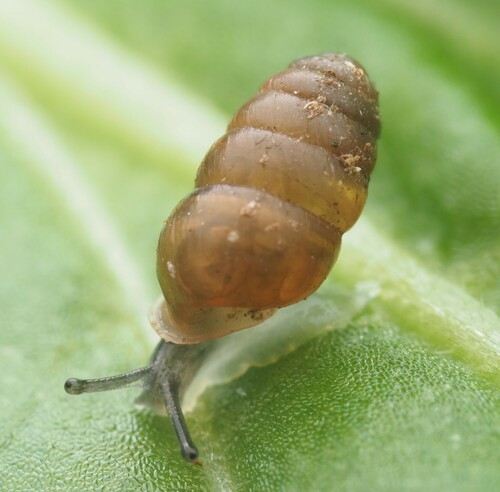
About Lauria cylindracea (Da Costa, 1778)
The shell of this species measures 3-4 by 1.8 millimeters. It has an oval shape, a blunt apex, and 5 to 6 weakly convex whorls, with the last whorl holding the largest diameter. The aperture features a parietalis, and may or may not have an angular tooth. In fully grown specimens, the shell margin is white, sharp, and reflected, and usually has a whitish parietal callus. The umbilicus is open and narrow. The shell is brown, transparent, shiny, and weakly striated. Juvenile specimens have extra folds that are visible from the outside of the shell. The soft body is dark, with lighter sides and foot. The upper tentacles are short, while the lower tentacles are very short. When crawling, the animal holds its shell in a high, almost straight position. This species is known to occur in Great Britain, Ireland, Ukraine, Portugal, Belgium, the Netherlands, and a number of other countries and islands. It has been introduced to British Columbia, Canada, and to New Zealand.

