About Laudakia tuberculata (Gray, 1827)
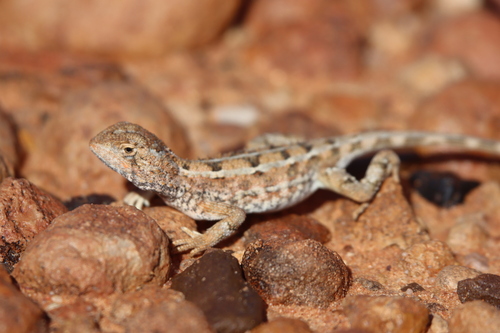
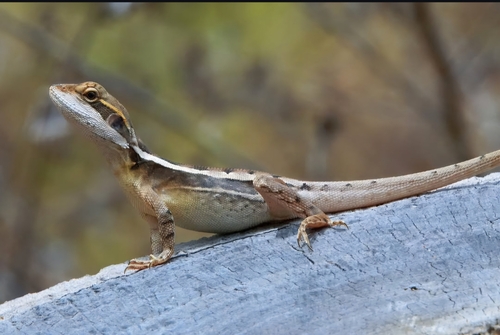
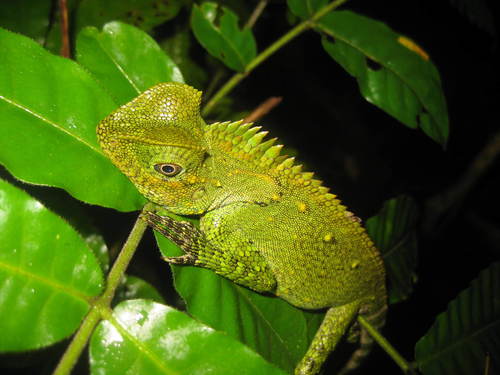
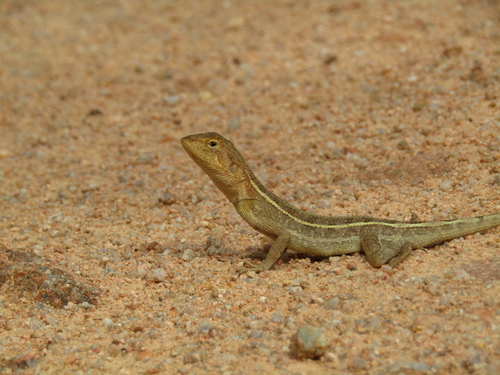
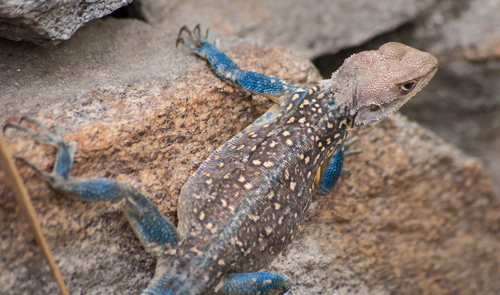
The head of Laudakia tuberculata is much depressed, and the snout is longer than the diameter of the orbit. The nostril is positioned laterally, below the canthus rostralis, and is slightly tubular. Scales on the upper surface of the head are smooth or feebly keeled; the occipital scale is not enlarged. Small, closely packed spinose scales are present on the sides of the head near the ear and neck. The ear is entirely exposed, and is larger than the eye opening. The throat is strongly plicate, and no gular pouch is present. The body is depressed, with a more or less distinct fold along each side of the back. Scales on the neck and sides are minute, almost granular, keeled, and either uniform or mixed with scattered enlarged scales. Scales in the vertebral region are enlarged, equal, rhomboidal, imbricate, and strongly keeled. There is only a very slight indication of nuchal denticulation. Ventral scales are smooth, and nearly as large as the enlarged dorsal scales. The limbs are strong, with compressed digits. Scales on the upper surface of the limbs are much enlarged and very strongly keeled. The third and fourth fingers are equal in length, or the fourth is very slightly longer. The fourth toe is slightly longer than the third toe, and the fifth toe extends beyond the first toe. The tail is rounded, much depressed at the base, and covered with moderate-sized strongly keeled scales arranged in rings. Its length is 2.5 to 3 times the distance from the gular fold to the vent. Males have a large patch of thickened preanal scales, plus a patch of similar thickened scales on the middle of the belly. The dorsal coloration is olive-brown, with blackish spots or speckles, and sometimes has small yellowish spots. Breeding males have a blue throat with light spots, and a light vertebral band is sometimes present. Laudakia tuberculata inhabits rocky mountain areas at elevations of 790 to 3,660 m (2,590 to 12,010 ft) above sea level.