About Laudakia nupta (De Filippi, 1843)
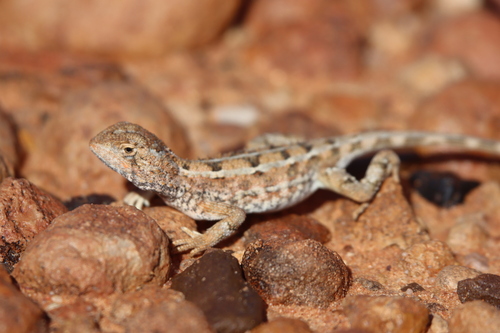
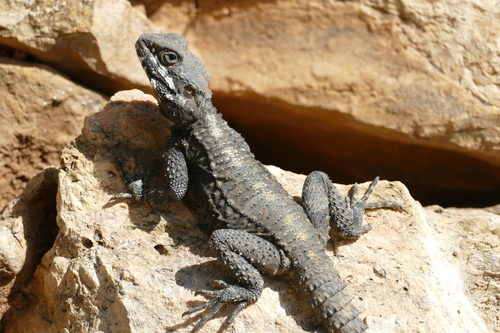
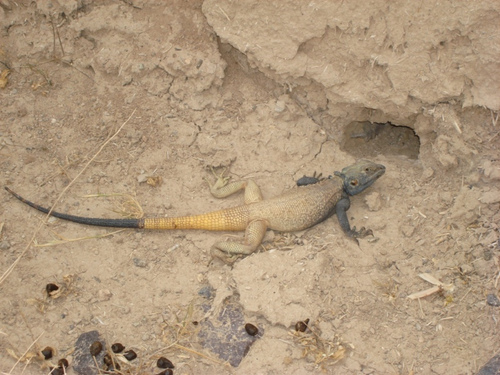
Laudakia nupta is a large lizard species, originally described by De Filippi in 1843. Individuals of this species have a heavy head, with nostrils located on the canthus rostralis. Their bodies are moderately depressed, and enlarged vertebral scales cover most of their back. They have long tails structured in segments made up of three whorls. This species reproduces via oviparity. Two recognized subspecies have distinct physical traits. The nominate subspecies, Laudakia nupta nupta, has a yellowish or reddish brown base color, and its enlarged vertebral scales are strongly keeled. The second subspecies, Laudakia nupta fusca, lacks a nuchal fold, and its enlarged vertebral scales are strongly mucronate. Laudakia nupta as a species occurs across western Asia. Laudakia nupta nupta is distributed in eastern Iraq, Iran, Afghanistan, and Pakistan. It occupies habitats including large limestone rocks and outcrops with deep crevices, as well as human-made structures such as mud-brick houses and old buildings. Laudakia nupta fusca is found in southern Pakistan and southern Iran.