About Latrodectus mactans (Fabricius, 1775)
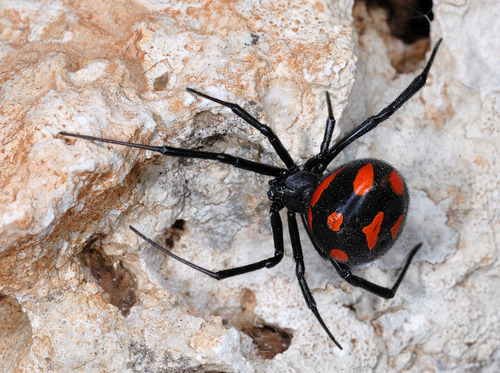
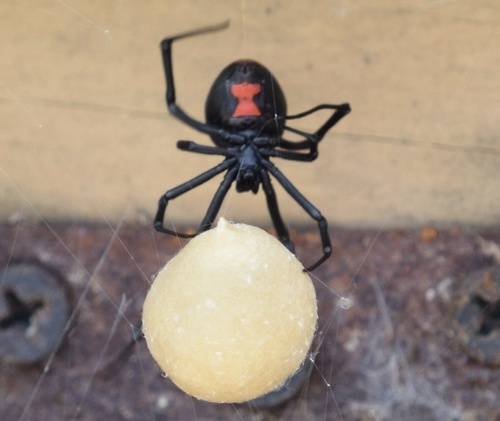
Mature female Latrodectus mactans have a body length (excluding legs) of 8–13 mm (0.31–0.51 in), while mature males measure 3–6 mm (0.12–0.24 in) in body length. Their legs are long relative to their body size. Females are shiny black, with a red hourglass-shaped marking on the ventral (underside) of their very rounded abdomen. Female size varies widely, especially among egg-carrying (gravid) individuals: the abdomen of a gravid female can reach over 1.25 cm (0.5 in) in diameter. Many females also have an orange or red patch just above the spinnerets on the top of the abdomen.
Juveniles have a noticeably different appearance from adults: their abdomens are grayish to black with white stripes across them, and are spotted with yellow and orange. Males are either purple, or have coloring similar to juvenile individuals. The web of this spider is a three-dimensional tangled cobweb made of exceptionally strong silk.
Latrodectus mactans, also called the southern widow, is primarily indigenous to the southeastern United States, with its range extending as far north as Ohio and as far west as Texas. The range of the northern black widow (L. variolus), which is found mainly in the middle Atlantic states, overlaps with the range of L. mactans. L. mactans is found across the entire country of the Dominican Republic, and across all of Mexico, where its range overlaps with that of Latrodectus hesperus and Latrodectus geometricus. Along with L. hesperus and L. geometricus, L. mactans is an established species in the Hawaiian Islands (USA). Imported produce is one entry pathway for at least one of these black widow species into Hawaii, and this is also considered an important potential pathway for widow spiders in other locations.
When a male L. mactans reaches maturity, it spins a sperm web, deposits semen onto the web, and loads its palpal bulbs with sperm. Reproduction is sexual: the male inserts its palpal bulbs into the female's spermathecal openings. The female lays her eggs inside a globular silken egg container, where the eggs stay camouflaged and guarded by the female. A female can produce 4 to 9 egg sacs in a single summer, with each sac holding 100–400 eggs. Eggs usually incubate for 20 to 30 days. It is rare for more than one hundred eggs to survive this incubation period. On average, thirty individuals survive through their first molt; the rest die from cannibalism, insufficient food, and/or lack of adequate shelter.
L. mactans takes 2 to 4 months to mature enough to breed, though full maturation typically takes 6 to 9 months. Females can live up to three years, while males have a lifespan of around 3 to 4 months. The female may eat the male after mating.