About Latrodectus katipo Powell, 1871
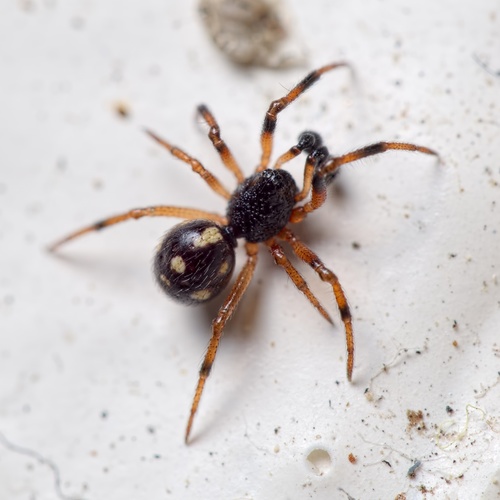
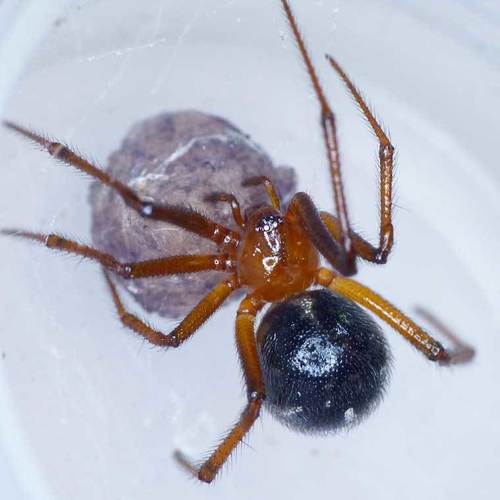
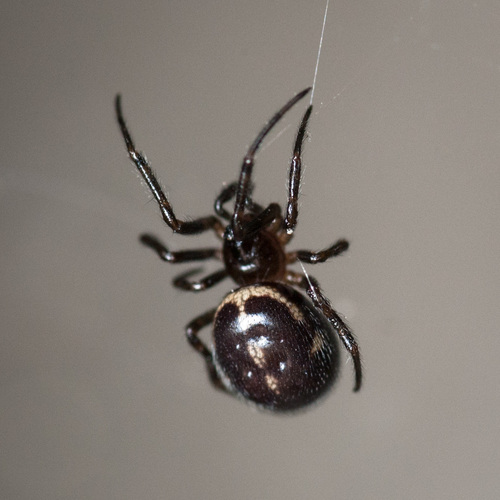
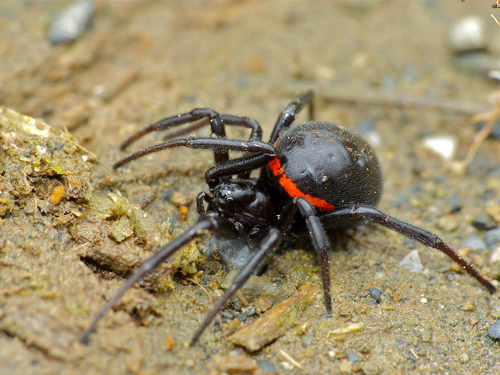
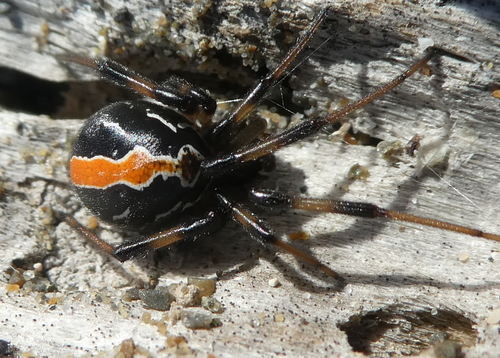
Description: As an adult female Latrodectus katipo, body length measures 8–10 millimetres (0.31–0.39 in), or 35–41 millimetres (1.4–1.6 in) when including leg span. Two main colour variants of this species are recognized: the red katipō and the black katipō. The red katipō is found in the South Island and lower North Island; it has a large, black, globular abdomen with a silky texture, and a distinctive white-bordered orange or red stripe running along its upper surface from the front of the abdomen to the spinnerets. The underside of the abdomen is black, with a red patch or partial red hourglass-shaped marking. The black katipō, found in the upper North Island, lacks the upper red or orange stripe on its abdomen, and its overall body colour is somewhat lighter than the red variant. The hourglass pattern on the underside of its abdomen may also be less distinct, often losing the middle section. Rare colour variations of black katipō exist where the abdomen, cephalothorax, or entire body is brown; these may sometimes have a dull red or yellow stripe, or cream-coloured spots on the upper side. The katipō is most closely related to its sister species Latrodectus hasselti. It can be distinguished from L. hasselti by the short setae (hair-like spines) covering its abdomen, while L. hasselti has a mix of long and short abdominal setae. There are also minor differences in the shape of female and male genital structures. The katipō may also be confused with Steatoda species, which often live in the same habitat. One Steatoda species, Steatoda capensis, is so similar to the katipō that it is commonly called "false katipō" in New Zealand. Compared to Steatoda capensis, the katipō has a less shiny abdomen, a more tapered abdomen, and its lateral eyes (located on the sides of the head) are further apart. Distribution and habitat: The katipō is only found in New Zealand. In the North Island, it occurs throughout the West Coast from North Cape to Wellington. On the North Island's east coast, it occurs irregularly, but is abundant on Great Barrier Island. In the South Island, it is found in coastal regions as far south as Dunedin on the east coast, and as far south as Greymouth on the west coast. It has been proposed that this southern range limit exists because katipō need warmer temperatures to allow their eggs to develop. The red katipō is found south of the western tip of Taranaki on the west coast, and just north of Waipatiki Beach in Hawke's Bay on the east coast. The black katipō is found north of Aotea Harbour in the Waikato region on the west coast, and north of Waipiro Bay in the Gisbourne region on the east coast. Both forms are found in a transition zone between these two sets of localities. These colour variants are strongly correlated with temperature: one study recorded that red katipō live in cooler areas with average temperatures between 11.24–13.85°C, while black katipō live in warmer areas with average temperatures between 13.64–16.23°C. The katipō is restricted to coastal sand dunes near the seashore. It generally lives on the landward side of dunes closest to the coast, where it is most sheltered from storms and sand movement. It can sometimes be found in dunes several kilometers inland when dunes extend that far from the sea. Webs are usually built among low-growing dune plants and other vegetation, such as the native pīngao (Ficinia spiralis) or introduced marram grass (Ammophila arenaria). It may also build its web under driftwood, stones, or other debris including rubbish. Researchers and conservationists can exploit this behaviour by placing plywood lids in katipō habitat; spiders hide under the lids, allowing easy population sampling. Webs are almost always built over open sand near the ground to catch crawling insects for food. Katipō living in dune grasses build their webs in open spaces between grass tufts, while those in shrubby areas build webs on the underside of plants that overhang open sand. Open sand patches are necessary for katipō to build webs; dense covering plants such as exotic kikuyu or buffalo grass create unsuitable conditions for web construction. The katipō commonly spins webs among pīngao, because this plant's growth pattern leaves patches of sand between individual plants. Marram grass has been extensively planted in New Zealand to stabilize sand dunes, and has largely replaced pīngao in many areas. Because marram grass grows in a very tight formation, leaving only small gaps between tufts, it is difficult for katipō to build a suitable prey-capturing web. As a result, studies show katipō are less abundant in marram-dominated dunes than in pīngao-dominated dunes. Reproduction: After reaching adulthood, the male katipō begins searching for a female to mate with, possibly guided by pheromones in the female's silk. The male enters the female's web and gently vibrates the silk as he approaches. The female is usually aggressive at first and will chase the male off the web. Courtship involves the male bobbing, plucking and tweaking the web, alternating between cautious approaches and being chased by the female. Eventually, when the female becomes docile and allows the male to approach, she hangs quietly upside down in the web, and the male moves to the underside of her abdomen. He taps her rapidly until their abdomens are aligned in the same direction, then inserts his palps (reproductive modified appendages) into the female's reproductive tract one at a time. Copulation lasts 10 to 30 minutes. After mating, the male retreats to groom, which he does by running his palps and legs through his fangs and wiping them across his body. Unlike some other widow spiders, the male is not eaten by the female after mating. The female lays eggs in November or December. The eggs are round, about the size of a mustard seed, and transparent purplish red. They are held together in a cream-coloured, round, ball-shaped egg sac that is about 12 millimetres (0.47 in) in diameter. The female builds five or six egg sacs over three to four weeks. Each egg sac holds about 70 to 90 fertilized eggs. The egg sacs are hung in the center of the spider's web, and the female spins extra silk over them; the sacs become covered in sand which partially conceals them. The eggs hatch after 20–25 days, and the juveniles continue developing inside the egg sac until they reach the second instar, at which point they feed on the egg sac wall. After four to six weeks of incubation, during January and February, the juveniles chew their way out of the egg sac, then disperse away from the web. In one 24-hour study of juvenile dispersal, 28% of juveniles used ballooning: they suspend themselves from a single web strand and use air currents to carry them away from the nest. 61% of juveniles used bridging: they use their silk to move to nearby plants. The remaining 11% stayed in the original nest. Because katipō and redback spiders (Latrodectus hasselti) are closely related, they can interbreed. A male redback can successfully mate with a female katipō to produce hybrid offspring. However, a male katipō cannot mate with a female redback, because male katipō are heavier than male redbacks. When a male katipō approaches a female redback's web, it triggers a predatory response from the female, and the male is usually eaten before mating can occur. There is evidence of interbreeding between wild katipō and redbacks, with one recorded specimen found to carry redback DNA in its maternal lineage.