About Latridopsis forsteri (Castelnau, 1872)
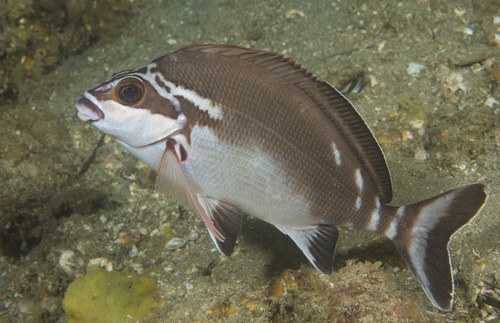
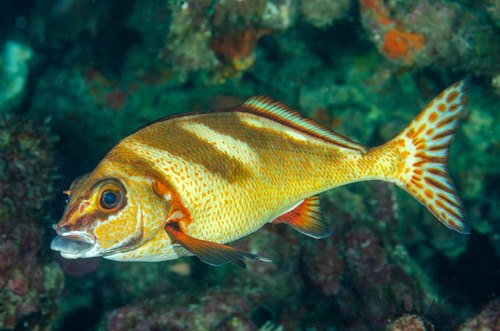
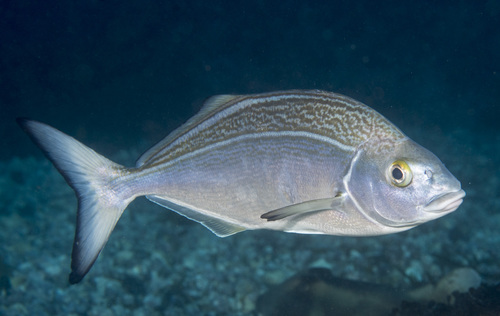
Latridopsis forsteri has a rather elongated, compressed, moderately deep body with a shallow caudal peduncle. Its dorsal and anal fins are low; the continuous dorsal fin has a deep incision between its spiny and soft-rayed sections. The dorsal fin contains 17 spines and 37 to 42 soft rays, while the anal fin has 3 spines and 31 to 37 soft rays. Its blunt pectoral fin has 16 to 19 rays, with upper rays longer than lower rays. The caudal fin is distinctly forked. This species reaches a maximum total length of 65 cm (26 in). Its overall body color is silver-grey, marked with short, irregular brown or greenish-brown longitudinal lines on the upper flanks. Adult individuals have a dark margin along the caudal fin, the pectoral fin has a black margin, and the eye is yellowish-white. Latridopsis forsteri is native to the eastern Indian Ocean and southwestern Pacific Ocean. Around Australia, it occurs from Victor Harbor, South Australia to Port Stephens, New South Wales, and also around Tasmania. In New Zealand, it ranges from Stewart Island in the south north to the Three Kings Islands, and east to the Chatham Islands. This species lives in coastal waters down to approximately 60 m (200 ft) deep. It is typically found swimming above sandy bottoms near rocky reefs. Larger adults usually form small schools that swim over deeper, less sheltered reefs. Juveniles are small, thin, and transparent in their early stage called 'paper fish', and form schools over rocky reefs in shallower waters.