About Latridopsis ciliaris (Forster, 1801)
Blue moki, whose scientific name is Latridopsis ciliaris (Forster, 1801), belong to the family Latridae, commonly known as trumpeters. This genus has four abundant subspecies in New Zealand waters. Blue moki are very similar to copper moki, another member of the same genus, in shape and size, but they differ in coloration during adulthood. Copper moki are native to New South Wales and Tasmania, and are rarely seen in New Zealand waters.
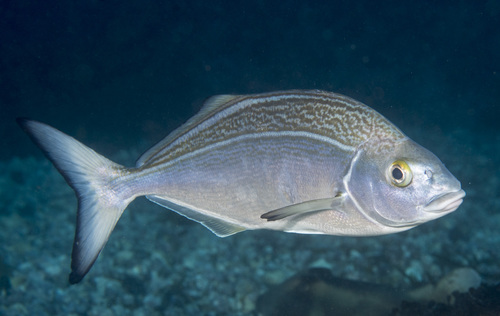
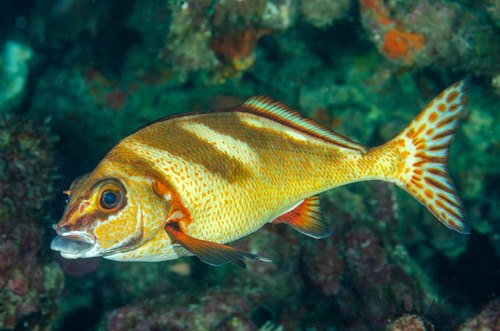
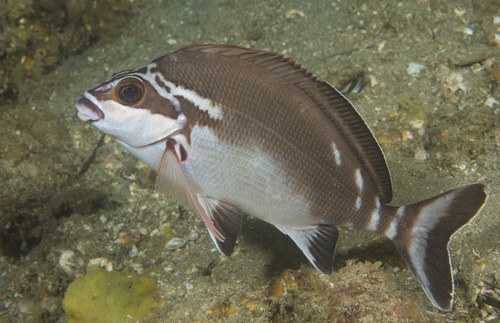
Blue moki match their common name in appearance: they have a dark blue to grey base body color, with an array of striking pink and olive tones. They have a distinct black edge along the caudal fin and the soft dorsal fin. Their body color changes throughout development: juvenile blue moki are green, transitioning to green-grey as adolescents, and becoming blue-grey when they reach large adult sizes.
Early research classified blue moki as an endemic species to New Zealand, but more recent records show the species has a wider distribution. It has been sighted off Tasmania and New South Wales. In Australia, blue moki are rare, with confirmed records from waters immediately south of Botany Bay near Sydney, and from Tasmania.
Within New Zealand, blue moki are widespread. Their distribution extends from the Kermadec Islands down through Stewart Island to the Auckland Islands, and they are abundant off the country’s east coast. They have also been recorded at the Chatham Islands. The size of the blue moki population on New Zealand’s west coast is not confirmed, but small commercial hauls of the species have been caught offshore from New Plymouth and Greymouth.
Blue moki inhabit the continental shelf from the Chatham Islands, ranging north and south, at depths between 10 and 200 metres. Many adults make an annual migration between Kaikōura and East Cape. Juvenile blue moki live inshore on coastal rocky reefs, which is their preferred shallow-water habitat. Most adult blue moki form schools offshore over open sandy bottom habitats, though some adults do not join these schools and remain in shallow rocky reef habitats.
Blue moki grow quickly, adding 5 to 6 centimetres to their length each year. Growth slows with age: fish between 10 and 20 years old typically reach 60 centimetres, and a 33-year-old individual over 80 centimetres long has been recorded. Blue moki can reach a maximum weight of 10 kg. They reach sexual maturity when they grow to 40 centimetres, which corresponds to an age of 5 to 6 years.
Their annual spawning migration starts in May or June, during the Southern Hemisphere winter. Blue moki travel north from Kaikōura on the South Island’s East Coast to the only confirmed blue moki spawning ground in New Zealand, located in the region from Māhia Peninsula to East Cape. Spawning takes place from August to September, and the adult fish pass back along the coast past Kaikōura in October. After hatching, the larval stage lasts approximately six months, before juveniles move inshore to coastal rocky reef habitats. Excluding mortality from commercial fishing, blue moki mortality rates are low.
Blue moki hold special cultural significance for Māori. Māori traditionally believe blue moki spawn at Cape Runaway, and the species has historical traditional fishing grounds where customary fishing was practiced in the past. Iwi consider set net fishing for blue moki in this area to be a cultural offense.