About Laticauda colubrina (Schneider, 1799)
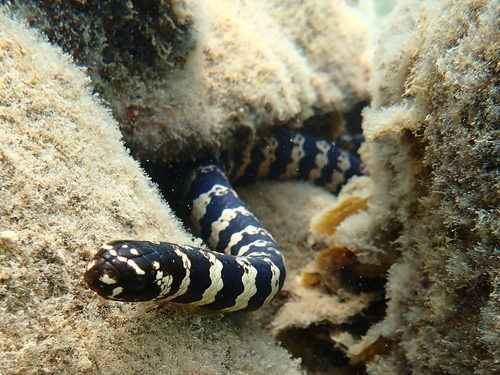
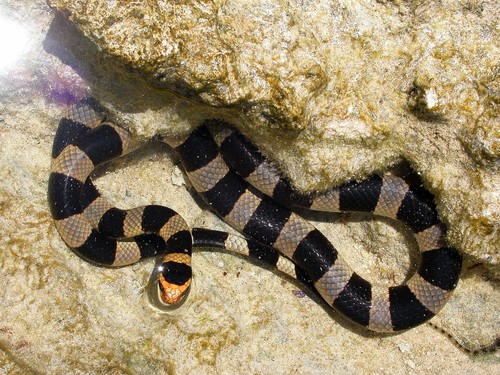
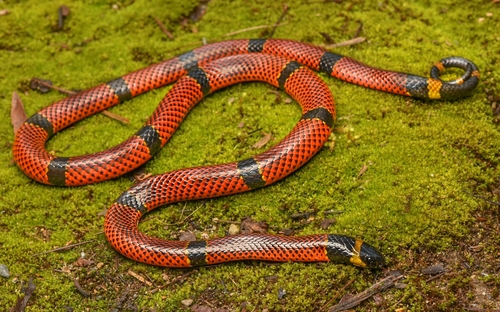
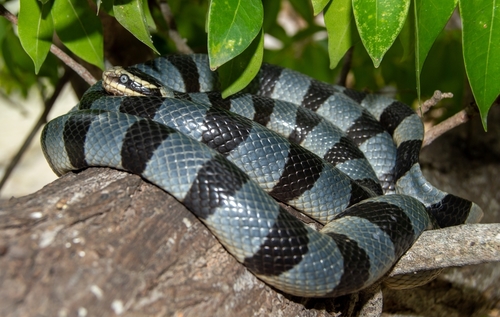
The yellow-lipped sea krait (Laticauda colubrina) has a black head with lateral nostrils and an undivided rostral scale. Its upper lip and snout are characteristically yellow, and this yellow color extends backward on each side of the head above the eye to the temporal scales. Its body is subcylindrical, taller than it is wide. The upper surface of the body is typically a shade of blueish gray, while the belly is yellowish. It has wide ventral scales that stretch from one third to more than half of the body's width. Black rings of roughly uniform width run along the full length of the snake, but these rings narrow or become interrupted at the belly. The midbody is covered in 21 to 25 longitudinal rows of overlapping (imbricated) dorsal scales. These dorsal and lateral scales can be used to tell this species apart from the similar yellow-lipped New Caledonian sea krait: the New Caledonian species typically has fewer scale rows, and its dark bands narrow or fail to meet ventrally, unlike this species' dark bands that meet on the belly. The yellow-lipped sea krait has a paddle-shaped tail adapted for swimming. On average, adult males reach a total length of 875 mm (2 ft 10.4 in), with a 13 cm (5.1 in) tail. Adult females are significantly larger, with an average total length of 1.42 m (4 ft 8 in) and an average tail length of 145 mm (5.7 in). This species is widespread across the eastern Indian Ocean and Western Pacific. Its range extends from India's eastern coast, along the Bay of Bengal coast through Bangladesh, Myanmar, and other Southeast Asian regions, to the Malay Archipelago, and parts of southern China, Taiwan, and Japan's Ryukyu Islands. It is also common near Fiji and other Pacific islands within its range. Vagrant individuals have been recorded in Australia, New Caledonia, and New Zealand. Six specimens have been found around New Zealand's North Island between 1880 and 2005, and are suspected to originate from populations in Fiji and Tonga. In New Zealand, this is the most common sea krait identified, and the second most commonly seen sea snake after the yellow-bellied sea snake. It is common enough to be considered a native protected species under New Zealand's Wildlife Act 1953. The yellow-lipped sea krait is oviparous, meaning it lays eggs that develop outside the parent's body. Each year, during the warmer months from September to December, males gather on land and in sheltered water around gently sloping areas at high tide. Males prefer to mate with larger females, because larger females produce larger and more numerous offspring. When a male detects a female, he chases her and begins courtship. Females are larger and slower than males, so multiple males will often escort and intertwine around a single female. The aligned males then rhythmically contract their bodies against the female, and this mass of snakes can remain nearly motionless for several days. After courtship, the snakes copulate for an average of around two hours. After mating, a female can lay up to 10 eggs per clutch. She deposits the eggs in rock or coral crevices, where they stay until hatching. Wild yellow-lipped sea krait eggs are very rarely encountered; only two nests have been definitively confirmed across the species' entire range.