About Lathagrium cristatum (L.) Otálora, P.M.Jørg. & Wedin
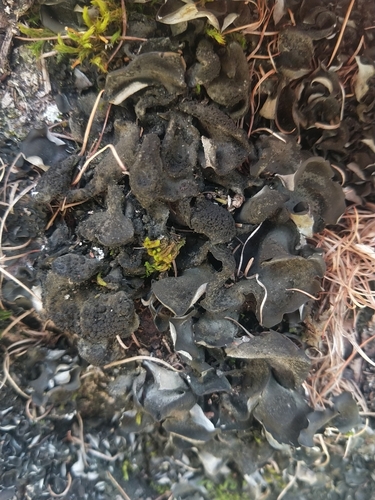
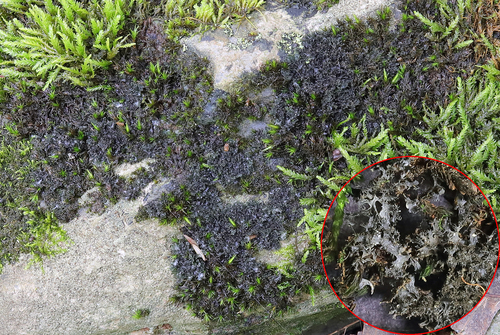
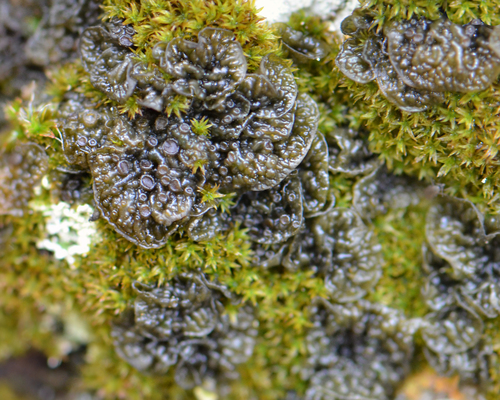
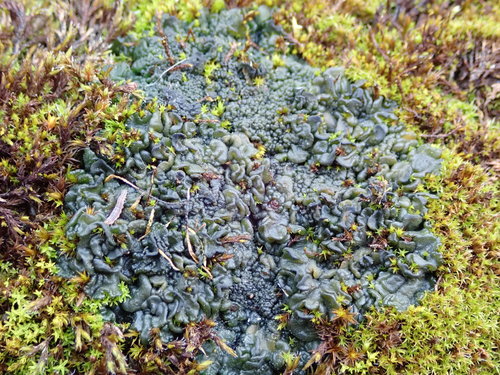
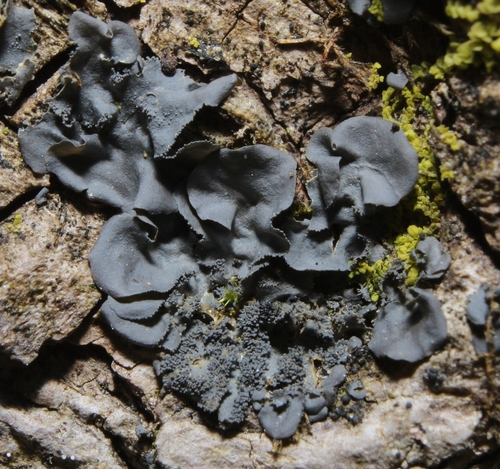
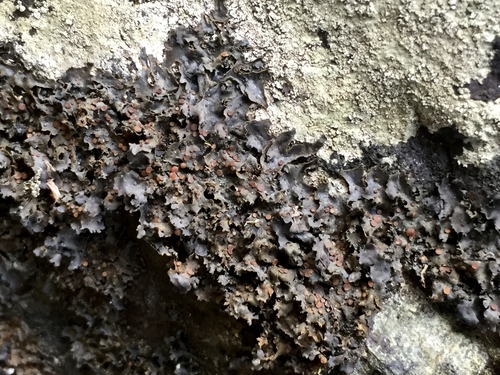
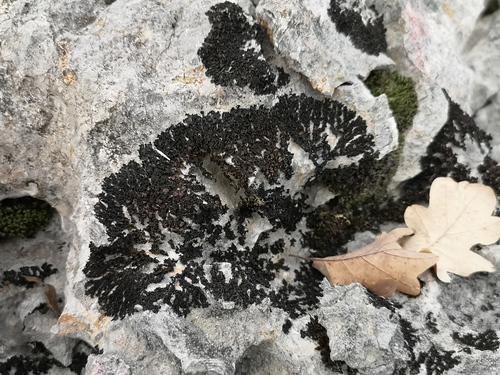
The thallus of Lathagrium cristatum forms foliose rosettes that usually measure 2–5 cm across, and may occasionally reach 10 cm. Its outline is rounded, semicircular, or irregular. In older colonies, the central parts often die away, leaving only a ring of living lobes. The lobes are fairly thin and narrow, reaching up to around 3 mm wide. They radiate outwards, are characteristically concave, branch irregularly, and may lie close together or remain more or less separate. Lobe margins are raised and wavy, ranging from nearly entire to distinctly cut or lobulate, and often have a sharply toothed outline. The upper surface is dark olive-green to brown, turning almost black in older or drier thalli. It generally lacks vegetative propagules, and isidia are only reported very rarely in some specimens. The underside has rounded attachment structures called hapteres that coalesce into conspicuous white tufts. Fruiting bodies called apothecia are often abundant, but may be absent from some thalli. They are mostly limited to lobe margins, where they form dense clusters of flat, disc-shaped structures up to 5 mm in diameter. These structures are either directly attached to the thallus or raised on short stalks, and each disc has an even rim made of thallus tissue, called a thalline margin. Asci typically hold four to six spores, and rarely hold up to eight spores. Ascospores are ellipsoidal with somewhat pointed ends, measuring around 18–32 × 8–13 micrometres (μm). They are somewhat muriform, with several internal cross-walls running in both transverse and longitudinal directions. In addition to apothecia, the species also produces asexual propagules. Conidiomata are common, and tend to grow along lobe margins in small, isidioid wart-like swellings. Conidia are colourless, cylindrical, and slightly swollen towards the tip, measuring around 4–5 × 1–2 μm. Some authors recognize two morphotypes within the species, which are sometimes treated as the varieties cristatum and marginale. Variety cristatum tends to form larger foliose rosettes, often more than 5 cm across, with fairly narrow (less than 2 mm), somewhat concave lobes that radiate outwards and branch irregularly. Variety marginale is similar in anatomy and spore characteristics, but differs in having more regularly furcate (forked) lobes. Both varieties are saxicolous to terricolous, and may occur together on the same calcareous substrates. Lathagrium cristatum has an extensive geographic range and is classified as a widespread Holarctic lichen. It has been recorded across North America, Europe, northern Africa, and Asia, including Siberia and the Himalayas. It occurs across a wide climatic range, from arid lowland deserts to arctic and alpine zones, as long as suitable substrate and moisture are available. For example, in the Sonoran region of southwestern North America it is found in scattered mountain localities in Arizona, Baja California and adjacent areas, and even occurs on the Channel Islands of California. It also reaches high latitudes and elevations, living in alpine and subarctic environments in areas such as Siberia and northern Europe. In more temperate regions it is often common; for example, in Great Britain and Ireland, this lichen occurs throughout both islands on suitable calcareous substrates. In Finland it is considered rare, and is known mainly from the south-western, eastern and northern parts of the country. This species is chiefly saxicolous, and typically grows on hard calcareous rock such as limestone or dolomite. Colonies form foliose, rosette-shaped patches that are firmly attached to rock, often in exposed sites that receive intermittent water flow from rain. In dry Mediterranean climates L. cristatum may be restricted to microsites where runoff water moistens the rock, for example along rain-tracks on cliff faces. Although it is a calciphile, it may occasionally colonize other substrates, including siliceous rock or calcareous soil, especially in crevices filled with sand or detritus. Its elevation range is broad: this lichen occurs from lowland areas up to montane and alpine zones, as long as the habitats are relatively undisturbed. The two recognized morphotypes, sometimes treated as varieties, are also distinguished by habitat differences. The typical variety, L. cristatum var. cristatum, extends into cooler climates and can reach the alpine belt, while L. cristatum var. marginale is reported to have a more southerly, warmth-favored distribution. Like other jelly lichens in the family Collemataceae, L. cristatum hosts a cyanobacterial photobiont made of filamentous Nostoc cells within its thallus. This symbiosis allows the lichen to fix atmospheric nitrogen. Lathagrium cristatum usually grows in natural, undisturbed habitats, and is seldom found in areas subject to heavy pollution or physical disturbance.