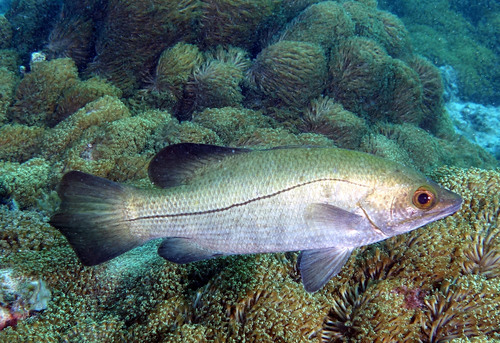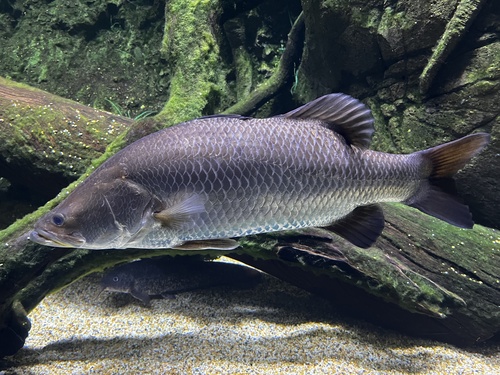
About Lates calcarifer (Bloch, 1790)
This species, Lates calcarifer, has a very elongated body, a large slightly oblique mouth, and an upper jaw that extends behind the eye. The lower edge of the preoperculum is serrated, with a strong spine at its angle; the operculum has a small spine and a serrated flap located above the origin of the lateral line. The fish has ctenoid scales. In cross-section, its body is compressed, and the dorsal profile of its head is clearly concave. The single dorsal and ventral fins have both spines and soft rays; the paired pectoral and pelvic fins have only soft rays; the caudal fin has soft rays, and is truncated and rounded. Barramundi are sportfish that live in both saltwater and freshwater, and are targeted by many anglers. They have large silver scales that can become darker or lighter depending on the environment they inhabit. Their bodies can grow up to 1.8 meters (5.9 feet) long, though there is very little evidence of individuals of this size being caught. The maximum recorded weight for this species is about 60 kilograms (130 pounds), while the average adult length is between 0.6 and 1.2 meters (2.0 to 3.9 feet). The genome of Lates calcarifer is approximately 700 Mb; this genome was sequenced and published in the journal Animal Genetics in 2015 by researchers from James Cook University. Barramundi are demersal fish that inhabit coastal waters, estuaries, lagoons, and rivers, and can be found in water ranging from clear to turbid, usually within a temperature range of 26 to 30 °C. This species does not carry out extensive migrations within or between river systems, which is presumed to have influenced the establishment of genetically distinct stocks of barramundi in Northern Australia. Barramundi feed on crustaceans, molluscs, and smaller fish, including other barramundi of their own species; juvenile barramundi feed on zooplankton. The species is euryhaline, but stenothermal. It lives in rivers, and migrates down to estuaries and tidal flats to spawn. In areas that are remote from fresh water, entirely marine populations of barramundi can become established. At the start of the monsoon season, males migrate downriver to meet females, which lay very large numbers of eggs—several millions per individual. Adult barramundi do not guard their eggs or newly hatched fry, which require brackish water to develop. The species is sequentially hermaphroditic: most individuals mature first as males, and become female after at least one spawning season. For this reason, most larger barramundi specimens are female. Captive-held barramundi sometimes show features that are not typical of wild individuals: they change sex at a smaller size, have a higher proportion of protogyny, and some captive males do not undergo sexual inversion. Barramundi are not generally kept in home aquaria. They are often confused with an Australian reef fish commonly called the humpback grouper (Cromileptes altivelis), which is also known as barramundi cod, panther grouper, or polkadot grouper. Juvenile humpback groupers are frequently offered for sale in the ornamental fish trade, but they rapidly outgrow most home aquariums. Barramundi have a mild flavour and white, flaky flesh, with varying amounts of body fat. They are a favourite prey of the region's apex predator, the saltwater crocodile, which have been recorded taking barramundi from unwary fishermen.