About Laterallus ruber (P.L.Sclater & Salvin, 1860)
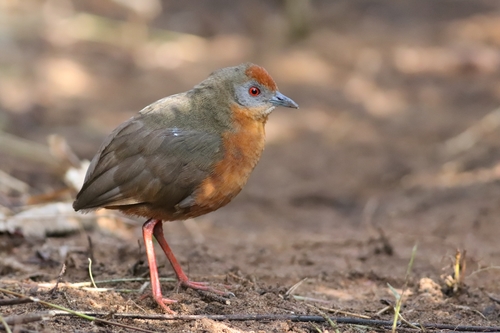
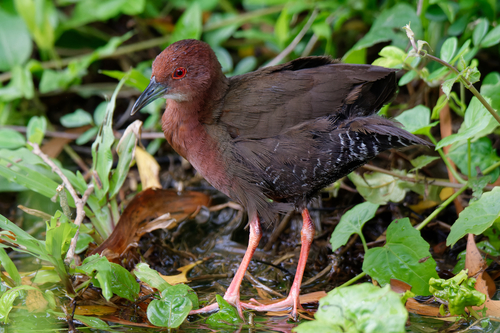
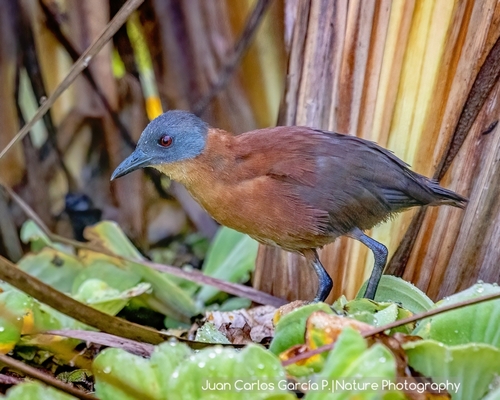
The ruddy crake (Laterallus ruber) can be identified by its variable-shade ruddy plumage, gray head, and dark brown wings and tail. It is mostly bright chestnut in color, with a paler chin and belly, a blackish crown, and dark grey ear-coverts. This is a very small crake, roughly sparrow-sized, measuring 14–16.5 cm in length. Immature ruddy crakes typically have discoloration on their midline or nape, such as a pale midline or chestnut-colored nape. The bill is black, the iris is red, and the legs and feet are olive-green; this yellowish-green leg color is a distinct trait that sets the species apart from other small birds. The ruddy crake has a short, black, conical bill, and broad feet adapted specifically for life in wet habitats. Female ruddy crakes are more drab in color than males; males have rusty red plumage on the breast. Like other members of the Rallidae family, the ruddy crake prefers wet pastures and marshes, especially areas with tall grasses. It inhabits lowlands across the Caribbean region, including eastern Veracruz, the Yucatan Peninsula, and Honduras. Its overall distribution extends from southern Mexico south to northwestern Costa Rica. It lives in freshwater habitats including marshes, reedbeds, damp fields, and ditches. In the 1960s and 1970s, the ruddy crake was considered the most abundant crake across its Mexican range, but it is classified as rare in Costa Rica. Based on range maps, its total breeding distribution covers 655,600 square kilometers. The Asociación Ornitológica de Costa Rica once listed the ruddy crake as possibly extinct, as there had been no confirmed sightings of the species in the country for two decades. However, a ruddy crake was observed near a trail at La Selva Biological Research Station in May 2007, confirming that the species still has a widespread range. For reproduction, ruddy crakes lay between 6 and 12 eggs in a plant-built nest placed near water. Males and females take turns incubating the eggs over a three-week period, and eggs hatch across a one-week window. While incubation continues for the remaining unhatched younger eggs, the male cares for already hatched chicks. Once all eggs have hatched, both parents feed and guard the chicks, and often split the group of chicks between themselves to care for.