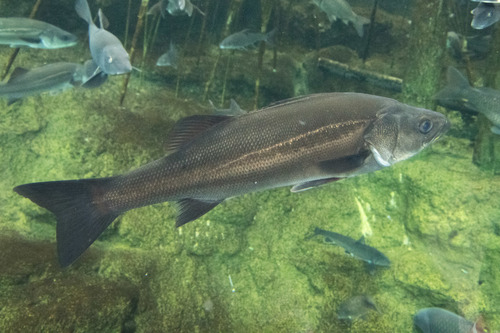
About Lateolabrax japonicus (Cuvier, 1828)
Description: The Japanese sea bass has a slightly forked tail and a large mouth, with its lower jaw protruding past the upper jaw. Young individuals have small black spots on the back and dorsal fin, which tend to be lost as fish grow larger. The first dorsal fin of this species holds 12 to 15 spines, followed by 12 to 14 soft rays in the second dorsal fin. The anal fin has 3 spines and 7 to 9 soft rays. The maximum recorded total length is 102 centimetres (3.35 ft), while a more common standard length is 16.1 centimetres (6.3 in), and the maximum published weight is 8.7 kilograms (19 lb). Distribution: Japanese sea bass are found in the Western Pacific, ranging from Japan to the South China Sea. Habitat and biology: This species lives on inshore rocky reefs with moving current. Juveniles have been recorded moving up into rivers, and adults return to the sea to spawn. It is a protandrous hermaphrodite: individuals reach sexual maturity as males at around 2 years old, and change into females as they age. Japanese sea bass larvae start feeding 4 days after hatching. Early larvae feed exclusively on small zooplankton such as cyclopoids and copepods; copepods make up the dominant part of their diet, accounting for nearly 70%. Once they reach the juvenile stage, their diet includes sardines, anchovies, shrimp, and other small fishes and crustaceans. Reproduction and development: This species spawns in coastal waters around Japan, specifically in shelf areas less than 100m deep, between late October and late January. Japanese sea bass eggs are generally distributed between bay water and outer water where thermohaline zones form. As eggs develop, they move from the water’s surface layer to the middle water layer. Water temperature strongly impacts egg survival rate, as the eggs cannot tolerate temperatures below 10 °C. The eggs are pelagic, spherical, and colorless, with diameters between 1.34mm and 1.44mm, and contain a single oil globule. The transformation from larva to juvenile stage happens between 49 and 70 days of age, and the juvenile stage begins at 60 days of age.

