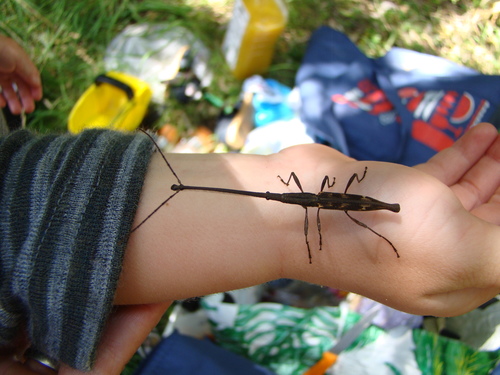
About Lasiorhynchus barbicornis (Fabricius, 1775)
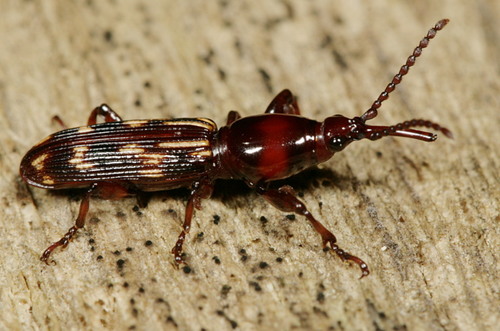
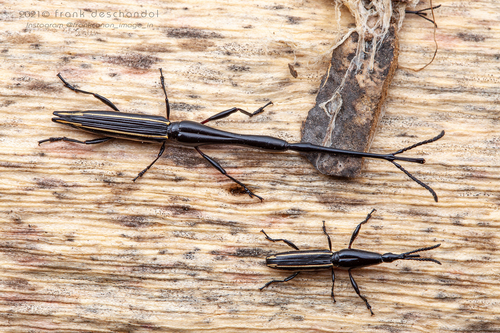
Giraffe weevils, scientifically named Lasiorhynchus barbicornis, have a distinctive elongated head and reddish-brown markings on their elytra. They are the only weevils in the world with a visible scutellum. They are New Zealand's longest native beetle, and researchers Christina J. Painting and Gregory I. Holwell have identified them as the longest brentid weevil in the world. Their size varies enormously: total length ranges from 15 to 90 mm in males and 12 to 50 mm in females. This wide variation in body size, particularly in the length of the male rostrum, may be a response to changing environmental conditions from year to year. Overall body size increases the further south the weevils live, but male rostra become proportionately shorter with increasing latitude. These weevils display extreme sexual dimorphism: males have an elongated rostrum (snout) with antennae at the tip, which they use as a weapon to fight over females. Female giraffe weevils have a shorter rostrum with antennae located about halfway along its length, which lets them bite egg-laying holes in tree trunks without damaging their antennae. Giraffe weevils are mostly active during the day, shelter in the canopy at night, and feed on sap. When suddenly disturbed, they drop backwards off tree trunks, lie in leaf litter, and play dead for up to an hour. Giraffe weevils are common in New Zealand's North Island. Though they are rarer there, they can also be found in the northwestern South Island, as far south as Greymouth. One individual has been recorded from the Hollyford Valley in Fiordland. Mitochondrial DNA evidence suggests that during the Pleistocene ice ages, giraffe weevils were only found in the remnant forests of Northland, and have expanded their range southward during the current interglacial period. According to studies conducted by Dr. Christina J. Painting for the Biological Journal of the Linnean Society, Lasiorhynchus barbicornis likely had a restricted habitat range during the Pleistocene era, and this range expanded after glacial retreat. As a result, there are now several distinct genetic populations of L. barbicornis. While the species lives throughout the areas of New Zealand where it occurs, populations in northern New Zealand have more genetic variation than populations in southern New Zealand. Northern populations live in the forests of the North Island, while southern populations occupy the warm, wet lowland forests of the western South Island. The life cycle of Lasiorhynchus barbicornis begins when a female lays a single egg approximately 3–4 mm deep into a tree, between the months of October and March. Females select egg-laying sites from a wide variety of native New Zealand tree species, including kauri (Agathis australis), lacebark (Hoheria spp.), pidgeonwood (Hedycarya arborea), rewarewa (Knightia excelsa), rimu (Dacrydium cupressinum), karaka (Corynocarpus laevigatus), tawa (Beilschmiedia tawa), and pukatea (Laurelia novae-zelandiae), and generally lay eggs on dying wood. To create an egg-laying site, the female bores a narrow hole with her mandibles into the tree trunk, pulling her head out every half-millimeter to clear away sawdust. After hatching, L. barbicornis larvae burrow into the tree's wood and live there for at least two years. Larvae do not eat wood; dissection observations confirm they feed on fungus that grows in the larval tunnels, not the wood itself. During the pupal stage, the weevil's rostrum is folded doubled underneath its body. When the adult beetle emerges, the rostrum straightens, and the adult eats its way out of the tree, leaving a square tunnel. Sometimes the tunnel is too narrow for the adult to exit, and the adult dies with its rostrum protruding from the tunnel. Adults exit trees as fully formed beetles during spring and summer, between October and March, with peak abundance in February. The overall adult sex ratio is approximately 60 males to 40 females. After emerging from the tree, adult L. barbicornis only live for a few weeks; one male was recorded to live at least 29 days.