About Lasiorhinus latifrons (Owen, 1845)
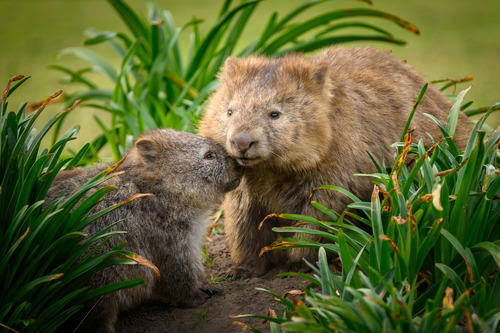
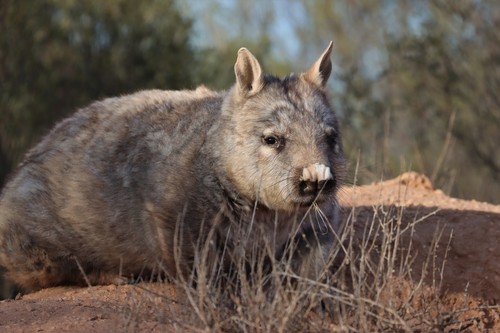
The southern hairy-nosed wombat, scientifically named Lasiorhinus latifrons (Owen, 1845), is well adapted for digging. It has a stocky, robust build, flattened claws, five digits on each foot, and is plantigrade. Body length ranges from 772 to 934 mm (30.4 to 36.8 inches), and body mass ranges from 19 to 32 kg (42 to 71 lb). Its short tail is completely hidden by its fur. The species has silky pelage, which is most commonly greyish or tan in colour. The wombat grooms itself using its second and third toes, which are fused together except at their tips. It has a robust, flattened head, pointed ears, and a pig-like snout. Its common name comes from the hairs that cover its rhinarium. The southern hairy-nosed wombat’s incisors are similar to those of rodents, its molars are widely separated by the palate, and all of its teeth grow continuously throughout its life. This continuous growth is likely an adaptation to the species’ harsh diet. Compared to the common wombat, the southern hairy-nosed wombat has a larger temporalis muscle and a smaller masseter muscle. Unlike the northern hairy-nosed wombat, it has a nasal bone that is longer than its frontal bone. Southern hairy-nosed wombats are distributed across Western Australia, southern South Australia, and south-western New South Wales. They inhabit semiarid to arid grasslands and woodlands. Breeding in the southern hairy-nosed wombat takes place when the species’ preferred food reaches peak growth. Reproduction depends on winter rainfall, which triggers germination of the grasses they prefer. When rainfall is sufficient between August and October, females enter ovulation, and males experience increased testosterone levels and increased prostate gland size; neither of these changes occur in years with low rainfall. During breeding seasons, males establish dominance hierarchies through aggressive interactions. Copulation occurs inside the species’ warren: males stay in a single burrow, while females move between different burrows. Mating happens underground, with the male mounting the female from behind while the female lies on her side. The gestation period lasts 22 days, and most births occur in October. After birth, the newborn climbs into the mother’s pouch and clings to a teat. It remains in the pouch for six months, growing to approximately 0.45 kg (1 lb), and develops light fur and open eyes while in the pouch. After leaving the pouch, the young wombat begins grazing on the surface. It is fully weaned at one year old, reaches full adult size at three years old, and also becomes sexually mature at this age. Recent molecular research has investigated the microbial community found in the southern hairy-nosed wombat’s pouch. This study found that the diversity and composition of pouch microbes correlates with the host’s reproductive status. Microbial diversity drops dramatically when the pouch contains a young, or when the mother is reproductively active. One possible interpretation of this finding is that the wombat can filter which microbes can live in the pouch, through antimicrobial peptides or other mechanisms. This filtering could be important for the health of the joey, since marsupials are born at a much earlier developmental stage than placental mammals and lack an adaptive immune system. Further research is ongoing to determine if the pouch microbes that survive the host’s filtering play beneficial roles in the protection and development of southern hairy-nosed wombat pouch young.