About Lasioptera rubi (Schrank, 1803)
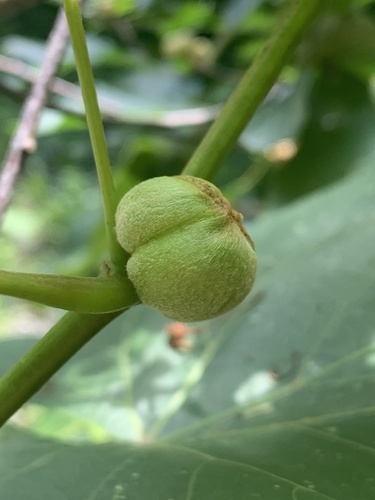
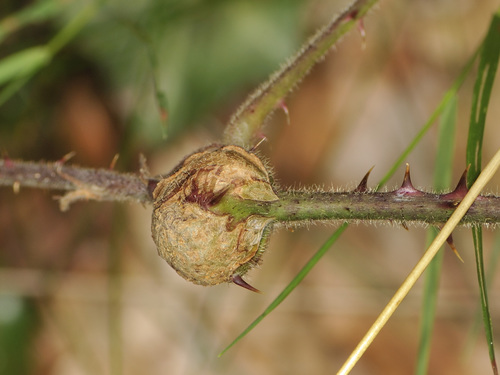
In early summer, the gall midge Lasioptera rubi lays clusters of up to forty eggs in young bramble shoots. Rapid growth of the plant’s tissue creates a 5 x 2 cm rounded swelling (gall) on the stem; the gall sometimes develops longitudinal fissures, and contains several irregular cavities that hold larvae. These cavities are lined with fungal mycelium, which the Lasioptera rubi larvae feed on. Young larvae are white, turning orange-red later in summer and through winter. Galls usually develop on one side of the bramble shoot, and occasionally spread to the opposite side. Newly formed galls are green, changing to reddish-brown as they mature. Larvae pupate the following spring, and adult Lasioptera rubi emerge in spring. Galls can sometimes form on a leaf petiole instead of the shoot. The similar gall wasp Diastrophus rubi produces elongate galls 2–15 cm long and around 1 cm wide, unlike the rounded 5 x 2 cm galls formed by Lasioptera rubi. This fly has been recorded in 24 European countries, ranging from Ireland, France and Spain in the west, to Finland, Ukraine and Russia in the east.