About Lasiopetalum baueri Steetz
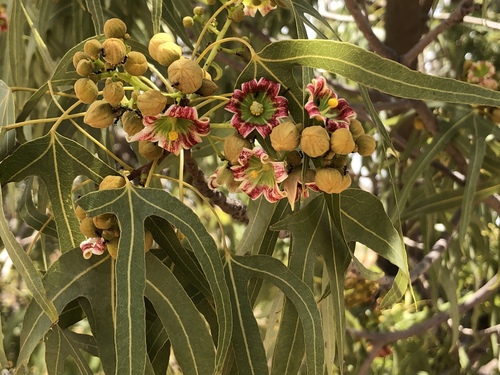
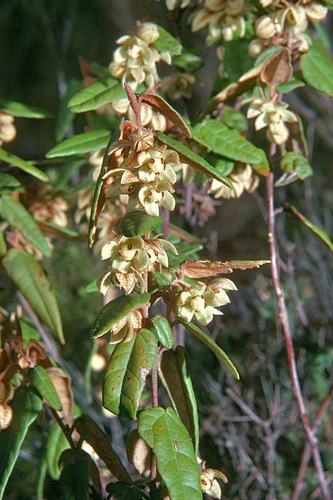
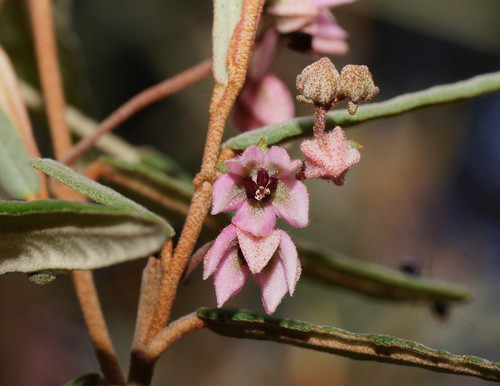
Lasiopetalum baueri is a greyish, densely leafed spreading shrub that reaches 0.3–1.5 m (12–59 in) in height and 1–2.5 m (3.3–8.2 ft) in width. Its new growth is prominently covered in red-brown hairs. Leaves of this species are linear to narrowly oblong or narrowly elliptic, 15–80 mm (0.59–3.15 in) long and 2–12 mm (0.079–0.472 in) wide, borne on a 2–4 mm (0.079–0.157 in) long petiole. Leaf margins are either flat or curved downwards; leaf undersides are hairy, while the upper surface becomes smooth with age. Flowers are arranged in sometimes crowded groups of two to six, with three 1.4–3.0 mm (0.055–0.118 in) long bracteoles at the base of each group. Sepals are 3.4–5.7 mm (0.13–0.22 in) long, usually pink or white with a green base, and their outer surface is densely covered in star-shaped hairs. Petals are less than 1 mm (0.039 in) long, and the reddish-brown anthers are around 1.5 mm (0.059 in) long. Flowering takes place from September to November, and the fruit is a densely hairy capsule 4–8 mm (0.16–0.31 in) in diameter. Commonly called slender velvet bush, this species is distributed in southern South Australia, central and western Victoria, northeastern Tasmania, and southwestern New South Wales where it is restricted to the area around Rankins Springs. It grows in mallee communities or on coastal cliffs, in sandy soil over limestone. The topsoil here is typically neutral to acidic, while the underlying subsoil is highly alkaline. In horticulture, Lasiopetalum baueri grows easily in drier climates when planted in well-drained soil and full sun. It is used as a windbreak or hedge, responds well to pruning, and was first introduced to cultivation in England in 1868. Its dried flowers are long-lasting and have potential as cut flowers.