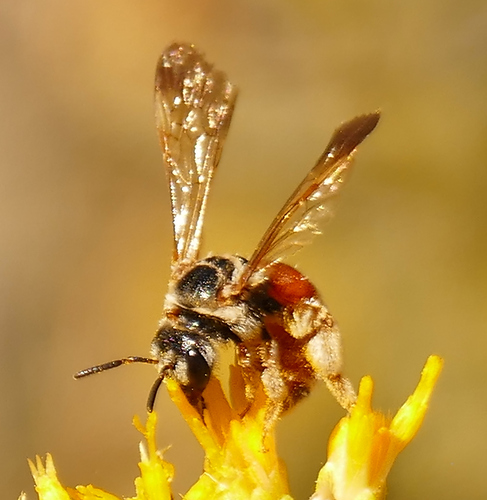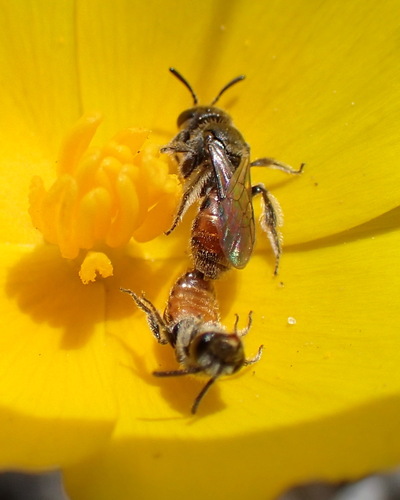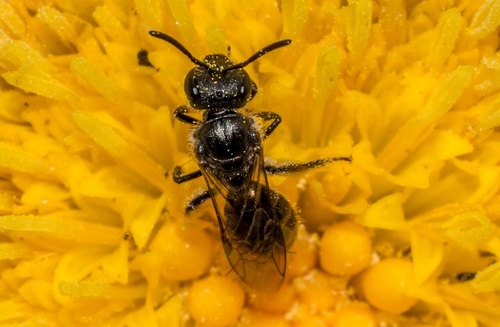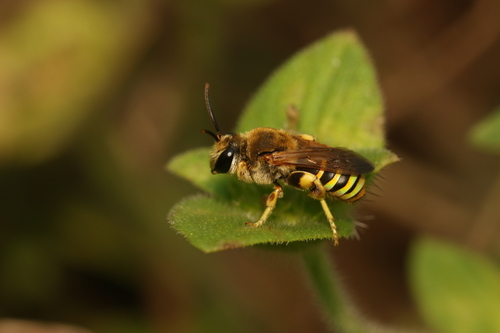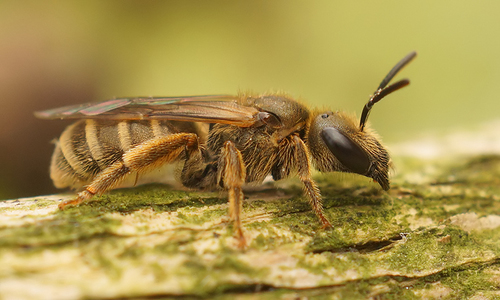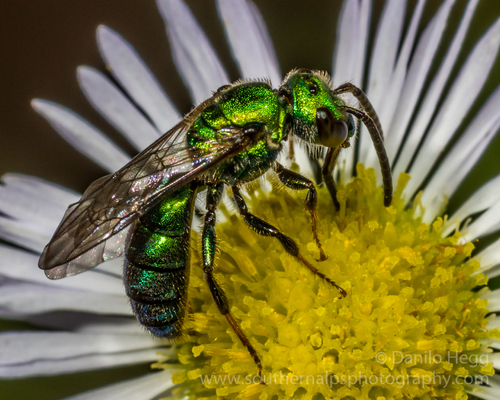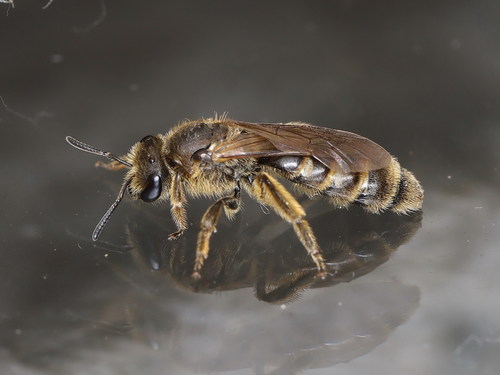
About Lasioglossum malachurum (Kirby, 1802)
This species, Lasioglossum malachurum, is a sweat bee with simple underground nesting architecture. Its nest consists of a vertical tunnel dug into the ground that ends in a compartment for rearing brood. Like the related species Lasioglossum zephyrus, L. malachurum nests underground, but does not build the same complex structures that L. zephyrus does. Nest entrances are often hidden by scattered foliage. Thousands of L. malachurum nests can occur in small areas in the form of nesting aggregations, which suggests the bees have some mechanism to identify nests of their own species. Both nest entrances and brood cell linings are marked with secretions from the bees' Dufour's gland, which plays a role in nest orientation. Nests are dug into hard, compact soil, and the queen can seal nests from within using her abdomen. Because digging a nest into hard soil requires a large energy investment from the queen, foundress bees (gynes) often usurp existing nests instead of building new ones from scratch. L. malachurum is a Western Palaearctic species, with a distribution that includes Southern England, the Channel Islands, most of continental Europe, and North Africa. Across this range, it can occupy a wide variety of habitats and climates. Climate differences between habitats often affect the social behavior of L. malachurum populations in those habitats. For example, summer length impacts the length of the breeding season, which in turn changes how many broods a queen can produce. Longer breeding seasons in Southern Europe can also lead to the development of reproductive capacity in worker bees, which means L. malachurum populations in these regions are not purely eusocial. As a result, female workers in southern European L. malachurum colonies have significantly more developed ovaries than female workers from northern European colonies. Because this species occupies a broad range of nesting habitats, it experiences a wide variety of climate-driven selective pressures that lead to location-specific differences in behavior. Researchers have found that L. malachurum in southern European climates tend to be more active, and produce more worker broods before producing a gyne brood, while L. malachurum in northern European climates are less active and only produce a single worker brood before the gyne brood. Lasioglossum malachurum is polylectic, which means it collects pollen from a wide range of unrelated plant species. While it is opportunistic when choosing which flowers to collect pollen from, it will generally narrow its pollen selection during any given collection period. This species shows floral consistency, and typically only collects pollen from a single source during a single pollen collection flight. The pollination behavior of L. malachurum may be useful for human cultivation and development, as this bee is known to pollinate plant species that humans commonly use for food and medication.