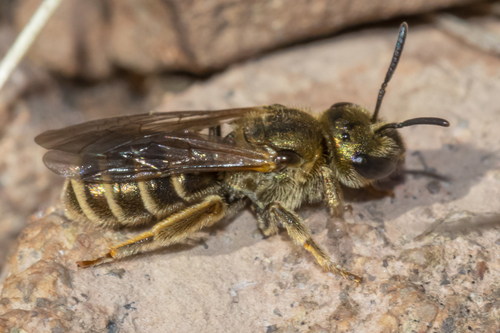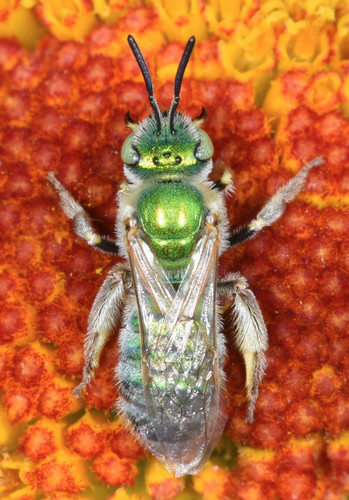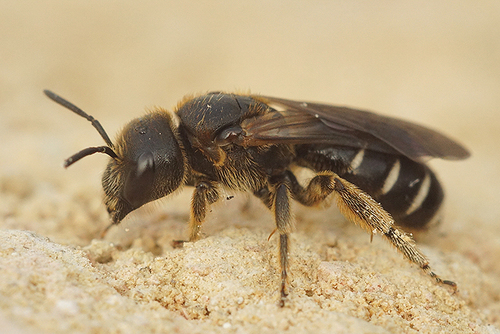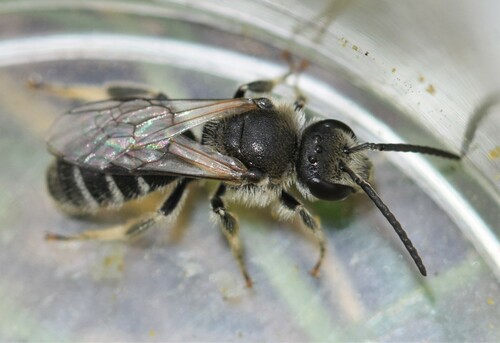
About Lasioglossum leucozonium (Schrank, 1781)
Description and identification: While Lasioglossum leucozonium is occasionally compared to its close relative L. zonulum, it has distinct features that set it apart from other Lasioglossum species. There are also visible differences in appearance between female and male L. leucozonium. Additionally, the eye of this species has been studied in comparison to the eye of the nocturnal bee Megalopta genalis. Distribution and habitat: L. leucozonium inhabits open areas, most commonly on sandy or chalky soil, and occurs more rarely on heavy clay. As a Holarctic bee species, it is found in North America from Wisconsin to New Jersey, extending north to Cape Breton Island, and is distributed throughout Europe. Although it is a solitary bee, its nests can sometimes occur in aggregations. Development and reproduction: L. leucozonium produces only one generation per year. Nest cells raise a sexual brood within the same year they are constructed. After offspring mature, they mate and then enter hibernation. Even with only one generation per year, females exit their underground sites twice annually: the first exit at the start of the season, when females build nests and mate, and the second after the brood departs to mate. Behavior and ecology: L. leucozonium is a diurnal, ground-nesting bee. It hibernates underground during the winter. At the time of hibernation, females have mated only once.