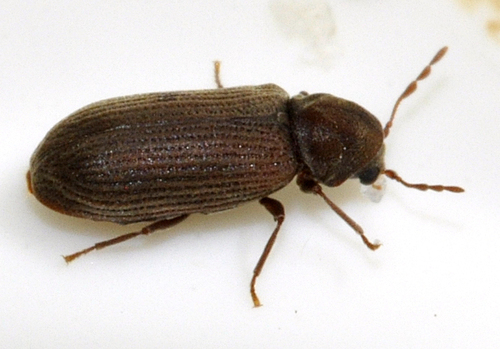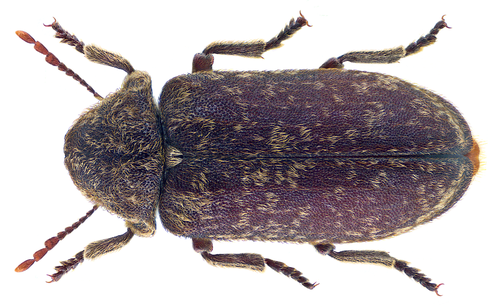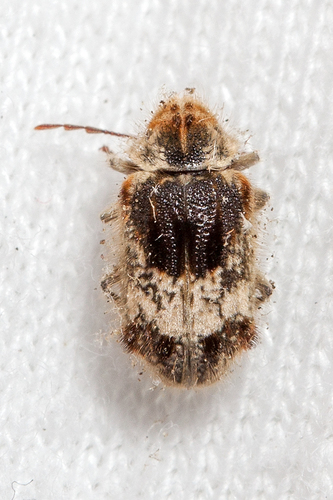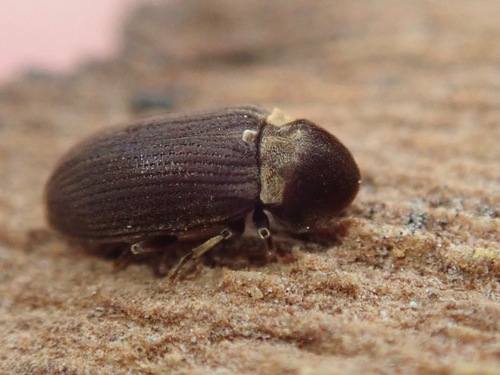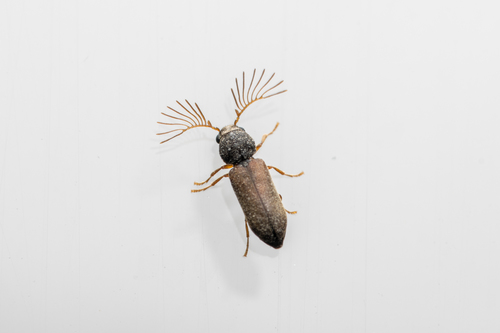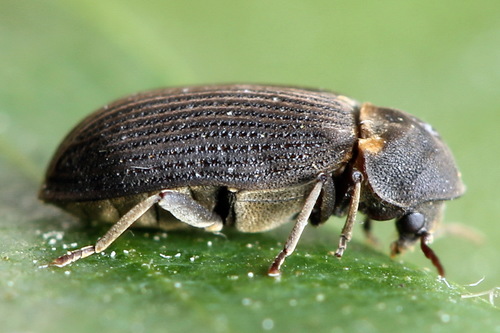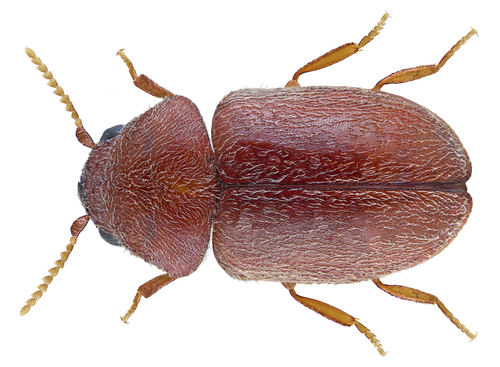
About Lasioderma serricorne Fabricius, 1792
Lasioderma serricorne (Fabricius, 1792) is a small beetle with many common names: cigarette beetle, cigar beetle, paprika beetle, tobacco beetle, tobacco bug, tobacco borer, tobacco weevil, cheroot beetle, and tow bug. The name tow bug comes from its habit of feeding on upholstery fillings including tow, hemp, and flax. This species belongs to the beetle family Ptinidae, along with the drugstore beetle (Stegobium paniceum) and the common furniture beetle (Anobium punctatum), and it resembles both of these species. It can be distinguished from A. punctatum by its flatter thorax (A. punctatum has a humped thorax) and by the lack of visible grooves on its elytra (hardened wing covers), while A. punctatum has grooves on its elytra. It can be told apart from S. paniceum by its uniformly serrated antennae with an unmodified apex, in contrast to the three-segmented apical club on S. paniceum’s antennae. L. serricorne also lacks the elytral grooves that are present in S. paniceum. Adult cigarette beetles are dark brown and measure 2 to 3 mm in length. Despite its small size, this species is a major pest of tobacco-related industries, which is the origin of its most common common names. Beyond tobacco, it infests a wide range of dry goods including cereals, dried fruits, herbs, flour, and certain animal products. Geographically, L. serricorne is naturally native to pan-tropical regions, but it has spread worldwide through the trade of infested dried goods, and can now be found anywhere that dried tobacco is stored. The species' distribution and reproductive success depend strongly on environmental temperature. Larvae cannot hatch below 15 °C or above 40 °C, and the optimal temperature range for maximum fecundity is 30 °C to 33 °C. High temperatures reduce adult longevity and fecundity, while a range of 33 °C to 37.5 °C shortens the preoviposition period and lengthens the oviposition period. Low temperatures are a major limiting factor for the species' geographic distribution, so it thrives best in tropical zones that match its preferred temperature range. L. serricorne is a strong flyer, a trait that supports its migration, lets it move easily from infested to uninfested food sources, and expands its geographic range and success as a pest. Among stored product insects, the cigarette beetle has one of the most varied diets, second only to Tribolium castaneum. Its primary food sources are stored commodities including spices, seeds, rice, cereals, and most notably dried tobacco leaves. The type of food source greatly influences the beetle's fecundity, developmental time, survival rates, and adult body weight. Wheat flour produces the highest fecundity, while tobacco leaves produce the lowest fecundity. Larvae raised in wheat flour also have the highest survival rate to adulthood. Among spices, cayenne pepper and paprika support the highest adult body weights and longest lifespans. L. serricorne is one of the few insect species able to live and feed on dry tobacco and tobacco products, even though tobacco is nutritionally poor and contains nicotine, a toxic botanical insecticide that is harmful to most soft-bodied insects. Researchers once thought cigarette beetles metabolized nicotine into the less harmful chemical cotinine, but recent research shows that over 91% of ingested nicotine passes through the beetle's digestive system unmetabolized and without causing harm, and leaves the body in frass (waste). It is hypothesized that gut microbes in L. serricorne support this ability to process nicotine harmlessly. Among different cured tobacco types, the beetle prefers flue-cured tobacco and least prefers Burley tobacco. This aligns with the species' general preference for tobacco types with higher sugar content and lower nicotine percentage.