About Larus schistisagus Stejneger, 1884
This species, Larus schistisagus Stejneger, 1884, is tied with the yellow-footed gull as the fourth-largest gull species. It measures 55–68.5 cm (21.7–27.0 in) in total length, has a wingspan of 132–160 cm (52–63 in), and weighs 1.05–1.7 kg (2.3–3.7 lb). Standard body measurements are as follows: wing chord 40 to 48 cm (16 to 19 in), bill 4.8 to 6.5 cm (1.9 to 2.6 in), and tarsus 6 to 7.6 cm (2.4 to 3.0 in).
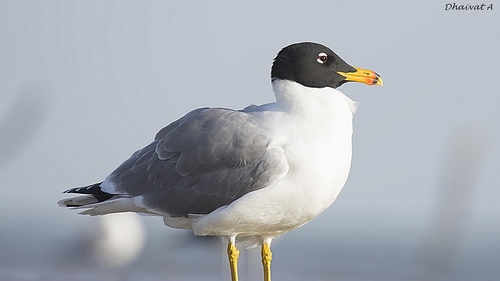
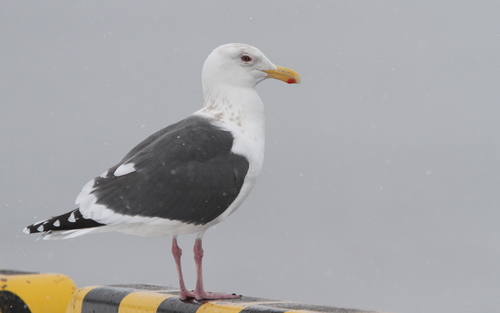
It has a white head, belly, and tail, paired with dark slaty-gray back and wings that have a broad white trailing edge. The back and wings are slightly darker than those of the western gull; on the Kodak grey scale, this species measures 9.5 to 12, compared to Kodak 9 to 11 for the darker southern subspecies of the western gull. The outer primaries (p9 and p10) bear small white spots called mirrors. The inner webs of the primaries are pale grey, and the mid-primaries have long grey markings tipped with large white crescents, forming a "string of pearls" pattern that connects to the broad white trailing edge of the secondaries.
Its eyes are yellow, surrounded by purple to deep pink orbital skin. The legs are pink and shorter than those of similar-looking gulls, and the body is stouter with a characteristic "pot-bellied" shape. The bill is yellow, with an orange-red subterminal spot, the spot near the bill end that chicks peck to stimulate adult regurgitative feeding. Immature slaty-backed gulls have brown plumage similar to that of the great black-backed gull, but paler, and are practically indistinguishable from immature herring gulls when observed in the field.
The slaty-backed gull is native to the Pacific coast of northeastern Asia. Individual birds have strayed to various locations across North America, including New England and Texas. On 3 November 2012, an individual was spotted in Finland, which was only the fourth recorded sighting of the species in Europe.