About Larus occidentalis Audubon, 1839
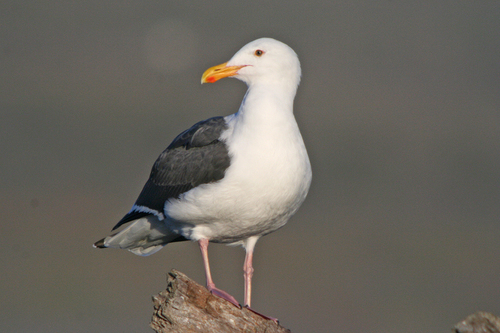
The scientific name of the western gull is Larus occidentalis Audubon, 1839. This is a large gull species. Adults measure 55 to 68 cm (22 to 27 in) in total length, have a wingspan of 130 to 144 cm (51 to 57 in), and weigh 800 to 1,400 g (1.8 to 3.1 lb). A survey of 48 individual western gulls found an average mass of 1,011 g (2.229 lb). Standard measurements for the species are as follows: wing chord 38 to 44.8 cm (15.0 to 17.6 in), bill 4.7 to 6.2 cm (1.9 to 2.4 in), and tarsus 5.8 to 7.5 cm (2.3 to 3.0 in). Western gulls have white heads and bodies, with dark grey upperparts (or a dark grey mantle). Their heads generally stay white year-round; northern populations develop little to no streaking on the head during the nonbreeding, or basic plumage, phase. It is debated how much head marking can appear in pure western gulls, because the species forms a hybrid zone with the glaucous-winged gull (Larus glaucescens), which has more extensive head marking. The western gull has a large yellow bill with a bulbous tip and a small red subterminal spot; chicks peck this spot to stimulate adult feeding. Eye color varies across populations: it averages pale yellow in southern populations and darker in northern populations. The western gull closely resembles the Asian slaty-backed gull (Larus schistisagus). However, slaty-backed gulls have paler eyes, a straighter bill, deeper pink legs and eye orbitals, and conspicuous white "string of pearls" spots on their inner primaries in flight that western gulls do not have. Western gulls take approximately four years to develop their full adult plumage. The largest western gull colony is located on the Farallon Islands, approximately 26 miles (40 km) west of San Francisco, California, and an estimated 30,000 western gulls live in the San Francisco Bay area. The species also inhabits the Oregon Coast. Two subspecies of western gull are currently recognized, differentiated by mantle color and average eye color. The northern subspecies L. o. occidentalis ranges from Central Washington to Central California, and has dark grey upperparts. The southern subspecies L. o. wymani ranges from central to southern California, has a darker mantle that approaches the darkness of the great black-backed gull's mantle, and averages paler eye color. L. o. wymani develops plumage more advanced than L. o. occidentalis, and generally reaches full adult plumage by its third year. The western gull's call is bright, piercing, and repetitive. Western gulls are year-round residents along the coasts of California, Oregon, Baja California, and southern Washington. They are migratory, and travel to northern Washington, British Columbia, and Baja California Sur to spend the nonbreeding season. For reproduction, western gulls build a vegetation nest inside the breeding pair's territory, and lay 3 eggs. The eggs are incubated for one month. After hatching, chicks stay within the breeding territory until they fledge. Chicks that stray into another gull's territory are often killed by the territory's breeding pair. Chick mortality is high, with an average of only one chick surviving to fledging. On occasion, other western gulls will adopt abandoned chicks.