About Larus michahellis J.F.Naumann, 1840
This species is the yellow-legged gull, with the scientific name Larus michahellis J.F.Naumann, 1840. It is a large gull with variable size: the smallest females are barely larger than common gulls, while the largest males are roughly the same size as great black-backed gulls. It measures 52 to 68 cm (20 to 27 in) in total length, has a wingspan of 120 to 155 cm (47 to 61 in), and weighs 550 to 1,600 g (1.21 to 3.53 lb). Standard measurements are as follows: wing chord 40.8 to 47.2 cm (16.1 to 18.6 in), bill 4.6 to 6 cm (1.8 to 2.4 in), and tarsus 5.6 to 7.5 cm (2.2 to 3.0 in).
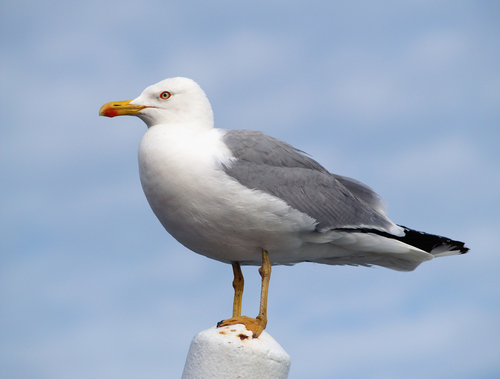
Adult yellow-legged gulls are externally similar to herring gulls, but can be distinguished by their yellow legs. They have a grey back that is slightly darker than a herring gull’s back, but lighter than a lesser black-backed gull’s back. In autumn, their heads are much whiter than related species. Their wing tips are more extensively black with few white spots, matching the pattern seen in lesser black-backed gulls. Like other gulls in its related species complex, adult yellow-legged gulls have a red spot on the bill. They have a red ring around the eye, which matches the lesser black-backed gull and differs from the herring gull, which has a dark yellow eye ring.
First-year yellow-legged gulls have paler heads, rumps, and underparts than first-year herring gulls, and their plumage more closely resembles that of first-year great black-backed gulls. They have a dark bill and dark eyes, pinkish grey legs, dark flight feathers, and a well-defined black band across the tail. As they mature, their underparts become lighter and they lose the patterned marking on their upperparts. By their second winter, yellow-legged gulls have nearly the same feathering as adults, with only patterned feathers remaining on the wing coverts. Second-winter birds still have black bill tips, dark eyes, and light yellow flesh-colored legs. The call of the yellow-legged gull is a loud laugh that is deeper and more nasal than the call of the herring gull.
The breeding range of the yellow-legged gull is centered on the Mediterranean Sea. In North Africa, it is common in Morocco, Algeria, and Tunisia, and its numbers are increasing in some areas; it has only recently begun breeding in Libya and Egypt. In the Middle East, a small number of yellow-legged gulls breed in Israel, Palestine, and Syria, with larger breeding populations found in Cyprus and Turkey. In Europe, breeding colonies exist all along the Mediterranean coast, as well as on Atlantic islands and coasts stretching north to Brittany and west to the Azores. It also breeds on the western side of the Black Sea, where its range overlaps with the Caspian gull; the two species differ in habitat preference, with the yellow-legged gull preferring sea cliffs and the Caspian gull preferring flatter shores. In recent decades, yellow-legged gulls have spread north into central and western Europe. Since 1995, one to four pairs have attempted to breed in southern England (sometimes forming hybrid pairs with lesser black-backed gulls), but colonization has proceeded very slowly.
Many yellow-legged gulls stay in the same area year-round, but others migrate to spend the winter in mild regions of western Europe, or travel as far south as Senegal, Gambia, and the Red Sea. There is also extensive northward post-breeding dispersal in late summer, leading to high numbers of the species in southern England from July to October. It has been recorded as a vagrant in northeastern North America and Nigeria.
Yellow-legged gulls usually breed in colonies. Clutches most often contain three eggs, which are laid from mid-March to early May. Adults vigorously defend their eggs and nest site. The nest is a sometimes sparse mound of vegetation built on the ground or on cliff ledges. In some locations including Gibraltar, Galicia, and Portugal, yellow-legged gulls have begun nesting on buildings within cities, and even on trees. The eggs are incubated for 27 to 31 days, and young birds fledge 35 to 40 days after hatching.