About Larus marinus Linnaeus, 1758
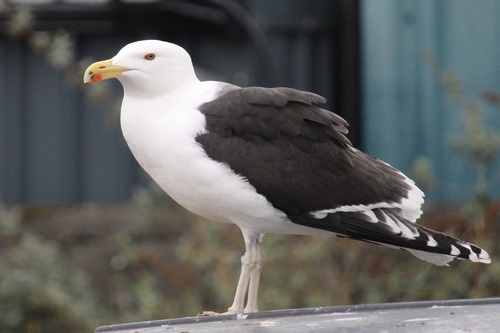
Larus marinus, commonly called the great black-backed gull, is the largest gull species in the world. It is considerably larger than the herring gull (Larus argentatus); only two other gull species, the glaucous gull (Larus hyperboreus) and Pallas's gull (Ichthyaetus ichthyaetus), come close to matching the great black-backed gull in size. One exceptionally large glaucous gull has been found that outweighs any known great black-backed gull, though the glaucous gull is usually slightly smaller on average. This species measures 64–79 cm (25–31 in) in total length, with a wingspan of 1.5–1.7 m (4 ft 11 in – 5 ft 7 in) and a body weight ranging from 0.75–2.3 kg (1 lb 10 oz – 5 lb 1 oz). In a 2009 sample of adult great black-backed gulls from the North Atlantic, males averaged 1,830 g (4 lb 1⁄2 oz) and females averaged 1,488 g (3 lb 4+1⁄2 oz). Some adults with access to fisheries in the North Sea can weigh up to roughly 2.5 kg (5+1⁄2 lb), with an average weight of 1.96 kg (4 lb 5 oz) for this group. Standard body measurements for the species are: bill length 5.4 to 7.25 cm (2+1⁄8 to 2+7⁄8 in), wing chord 44.5 to 53 cm (17+1⁄2 to 20+3⁄4 in), and tarsus length 6.6 to 8.8 cm (2+5⁄8 to 3+1⁄2 in). Great black-backed gulls have a bulky, imposing appearance, with a large, powerful bill. Adult great black-backed gulls are fairly distinctive: no other very large gull with black upper-wings is generally found in the North Atlantic. Among other white-headed North Atlantic gulls, the mantle is typically a lighter grey, and can even be a light powdery grey or pinkish in some species. Adult great black-backed gulls are greyish-black on their wings and back, with conspicuous contrasting white "mirrors" at the wing tips. Their legs are pinkish, and their bill is yellow or yellow-pink with some orange or red marking near the tip of the lower bill. The smaller lesser black-backed gull (L. fuscus) is distinctly smaller than the great black-backed gull, typically weighing about half as much. Lesser black-backed gulls have yellowish legs and a mantle that ranges from slate-grey to brownish, and is never as dark as the mantle of the great black-backed gull. A small number of superficially similar dark-backed, fairly large gulls live in the Pacific Ocean or the tropics, all generally far outside the range of the great black-backed gull; these include the slaty-backed gull (L. schistisagus), the western gull (L. occidentalis), and the kelp gull (L. dominicanus). Juvenile great black-backed gulls under one year old have scaly, checkered black-brown upper parts, with streaked grey-brown head and underparts, and a distinct neat wing pattern. The juvenile's face and nape are paler, and its flight feathers are blackish-brown. The juvenile tail is white with zigzag bars and spots at the base, plus a broken blackish band near the tip. A juvenile's bill is brownish-black with a white tip, and its legs are dark bluish-grey with some pink tones. As young gulls age, the grey-brown juvenile plumage gradually fades to develop more contrasting adult plumage, and the bill darkens to black before growing paler. By the third year, young great black-backed gulls resemble a streakier, dirtier-looking version of mature adults. This species takes at least four years to reach sexual maturity, a slower development than that seen in other large gull species. The call of the great black-backed gull is a deep "laughing" cry, transcribed kaa-ga-ga; the first note is sometimes drawn out into a sound almost like a bovine's call. The voice of this species is distinctly deeper than the voice of most other gull species. Great black-backed gulls breed in coastal areas ranging from extreme northwestern Russia, through most of coastal Scandinavia and along Baltic Sea coasts, to the coasts of northwestern France, the United Kingdom, and Ireland. Across the northern Atlantic, the species is distributed in Iceland, the Faroe Islands, southern Greenland, and along the Atlantic coasts of Canada and the United States. Though the species was formerly mainly just a non-breeding visitor south of Canada in North America, it has spread to establish several colonies in the New England states, and now breeds as far south as North Carolina. Individuals that breed in harsher northern environments migrate south for winter. They winter on northern coasts of Europe from the Baltic Sea to southern Portugal, and regularly reach as far south as coastal Florida in North America. During winter in the Baltic Sea, the species usually stays close to the ice boundary. North of the Åland islands, the sea often freezes solid all the way from Sweden to Finland, so in these conditions great black-backed gulls migrate to open waters. In exceptional cases, the species can range as far south as the Caribbean and off the coast of northern South America. The great black-backed gull occupies a variety of coastal habitats, including rocky and sandy coasts and estuaries, and also uses inland wetland habitats such as lakes, ponds, rivers, wet fields, and moorland. When ranging inland, individuals are generally found within striking distance of large bodies of water. Today, the species is a common sight at refuse dumps both along coasts and relatively far inland. It also makes extensive use of dredge spoils; in the U.S. state of New Jersey, dredge spoils are the species' most common nesting sites. Great black-backed gulls generally breed in areas that are free of terrestrial predators, or largely inaccessible to them, including vegetated islands, sand dunes, flat-topped stacks, building roofs, and sometimes among bushes on salt marsh islands. During the winter, great black-backed gulls often travel far out to sea to feed.