About Larus heermanni Cassin, 1852
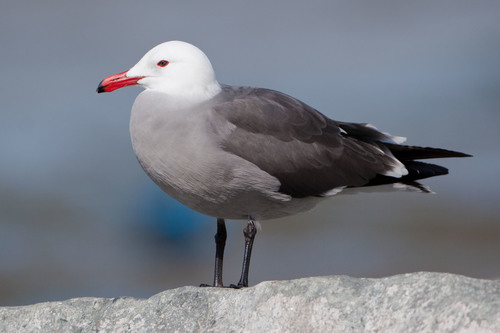
Heermann's gull, scientific name Larus heermanni Cassin, 1852, has a distinct appearance that sets it apart from other gull species. Adult individuals have a medium gray body, blackish-gray wings and tail with white edges, and a red bill marked with a black tip. Their head is dusky gray when in non-breeding plumage, and turns white during breeding season. Immature gulls look similar to non-breeding adults, but are darker and browner overall, and retain a pink bill until their second winter. Roughly one out of every 200 individuals has white primary coverts that form a prominent visible spot on the upper wing. This species is unlikely to be confused with other gulls, because it is the only white-headed, gray-bodied gull that occurs on the west coast of North America. Its calls are deep and follow the same general pattern as calls of other gulls, but have a noticeably different sound quality. The current total population of this species is around 150,000 breeding pairs, with 90% of all pairs nesting on Isla Rasa, an island in the Gulf of California off Baja California. Smaller breeding colonies are found as far north as California and as far south as Nayarit. After the breeding season ends, gulls most commonly disperse to central California. Less commonly, dispersing individuals travel as far north as British Columbia and as far south as Guatemala. Some individuals show strong site fidelity to their nonbreeding territories; this includes a one-legged gull that lived for 17 years at the Loch Lomond Marina in San Rafael, California. As of 1999, the only known active breeding colony of Heermann's gull in the continental United States was in Seaside, California, where a small number of gulls nested on artificial fill islands in Roberts Lake. By 2007, the islands had eroded completely away, but the colony continued nesting on nearby rooftops. In June 2018, one of the colony's main nesting sites located at the Seaside McDonald's was destroyed in a drunk driving crash. In April 2019, after receiving a permit from the City of Seaside, the Monterey Audubon Society placed a floating artificial nesting island in Roberts Lake to restore lost nesting territory for the colony.