About Larus fuscus Linnaeus, 1758
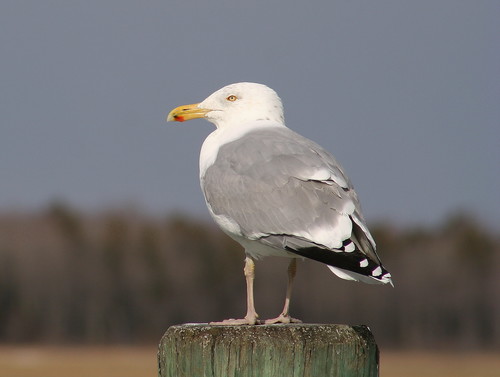
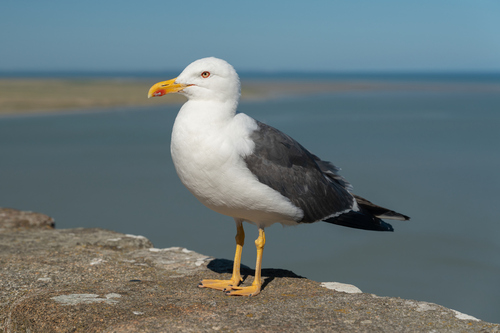
This species, the lesser black-backed gull, is smaller than the European herring gull. The herring gull/lesser black-backed gull species complex has complicated taxonomy; different scientific authorities recognize between two and eight species within this group. This group forms a ring species with a distribution that circles the Northern Hemisphere. Differences between adjacent forms in this ring are fairly small, but when the full circuit is completed, the end members – herring gull and lesser black-backed gull – are clearly distinct species. The lesser black-backed gull measures 51–64 cm (20–25 in) in body length, has a wingspan of 124–150 cm (49–59 in), and weighs 452–1,100 g (0.996–2.425 lb). The nominate race averages slightly smaller than the other two recognized subspecies. Males average 824 g (1.817 lb), making them slightly larger than females, which average 708 g (1.561 lb). Measured body dimensions include: wing chord 38 to 45 cm (15 to 18 in), bill 4.2 to 5.8 cm (1.7 to 2.3 in), and tarsus 5.2 to 6.9 cm (2.0 to 2.7 in). The great black-backed gull is an easily confused species; the lesser black-backed gull is much smaller, has a slimmer build, yellow rather than pinkish legs, and smaller white "mirrors" at the wing tips. Adult lesser black-backed gulls have black or dark grey wings and back, with exact color varying by subspecies. Their bill is yellow with a red spot, which young gulls peck to induce feeding from adults (a behavior related to the fixed action pattern). Unlike the great black-backed gull, the lesser black-backed gull's head becomes greyer in winter. Annual moult for adults begins between May and August, and some individuals do not complete their moult until November. A partial prebreeding moult occurs between January and April. Juvenile birds have scaly black-brown upperparts and a distinct neat wing pattern. They take four years to reach sexual maturity. Juvenile lesser black-backed gulls can be most readily distinguished from juvenile herring gulls by their more solidly dark, unbarred tertial feathers. Their call is a "laughing" cry similar to that of the herring gull, but it has a noticeably deeper pitch. The lesser black-backed gull has expanded its range westward, first colonizing Greenland in the 1980s. The species has not yet been recorded breeding in the United States, though hybrid pairs between lesser black-backed gulls and American herring gulls have been documented twice.