About Larus cachinnans Pallas, 1811
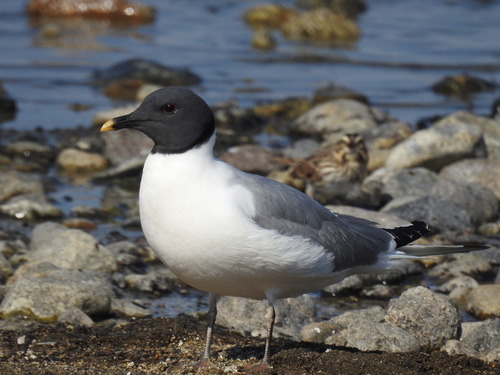
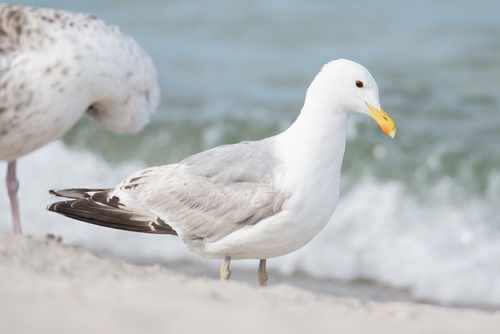
Larus cachinnans, commonly called the Caspian gull, is a large gull species. Adults measure 56–68 cm (22–27 in) in total length, have a wingspan of 137 to 155 cm (54 to 61 in), and weigh 680–1,590 g (1.50–3.51 lb). Standard measured dimensions are: wing chord 38.5 to 48 cm (15.2 to 18.9 in), bill 4.6 to 6.4 cm (1.8 to 2.5 in), and tarsus 5.8 to 7.7 cm (2.3 to 3.0 in). The Caspian gull has a long, slender bill, with a distinct sloping forehead that emphasizes the bill's shape. Its legs, wings, and neck are all longer than those of the herring gull and yellow-legged gull. The eye is small and often dark, and leg color ranges from pale pink to pale yellowish. The back and wings are a slightly darker shade of grey than the herring gull's, but slightly paler than the yellow-legged gull's. The outermost primary feather has a large white tip and a white stripe running up the inner web. First-winter Caspian gulls have a pale head with dark streaking on the back of the neck, pale underparts, and a greyish back. The greater and median wing coverts have whitish tips that form two pale lines across the wing. Multiple peer-reviewed ornithology articles have been published on Caspian gull identification, including: Garner and Quinn (1997) in British Birds; Bakker, Offereins, and Winters (2000) in Birding World, an identification gallery with 34 images of Caspian gulls of various ages; Jonsson (1998) in Alula; Neubauer and Millington (2000) in Birding World, which addresses identification of Caspian gulls in juvenile plumage; Small (2001) in Birding World; and Gibbins, Small, and Sweeney (2010) in British Birds, a detailed identification paper covering typical individual birds. The Caspian gull breeds around the Black and Caspian Seas, extending east across Central Asia to north-west China. In Europe, the species has been spreading north and west, and now breeds in Poland, eastern Germany, and southern Russia; it is present year-round in Ukraine. Some individuals migrate south as far as the Red Sea and Persian Gulf, while others disperse into Western Europe, including countries such as Sweden, Norway, Denmark, the Benelux countries, and even northern France. Small numbers are now seen regularly in Britain, especially in South-east England, East Anglia, and the Midlands.