About Larus armenicus Buturlin, 1934
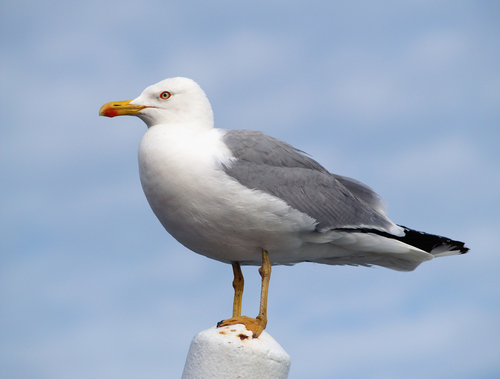
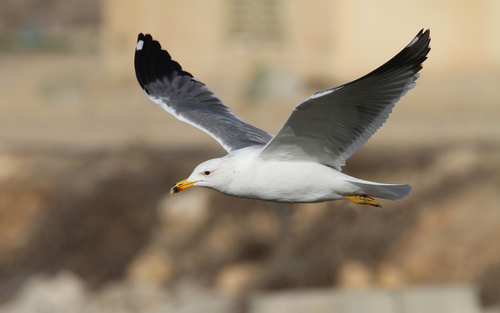
The Armenian gull, scientifically named Larus armenicus Buturlin, 1934, is a fairly large gull species. On average, it is the smallest gull in the herring gull complex. Adults measure 52 to 62 cm (20 to 24 in) in total length, have a wingspan of 120 to 145 cm (47 to 57 in), and weigh 600 to 960 g (1.32 to 2.12 lb). Its recorded standard measurements are: wing chord 38.5 to 45.8 cm (15.2 to 18.0 in), bill 4.1 to 5.6 cm (1.6 to 2.2 in), and tarsus 5.7 to 6.4 cm (2.2 to 2.5 in). This gull is superficially similar to yellow-legged gulls, but it is slightly smaller, has a slightly darker grey back, and has dark eyes. It also has more extensive black markings on its wingtips, with smaller white spots. Its bill is short, with a distinct black band located just before the tip. First-winter Armenian gulls are mainly brown, with a whitish rump, pale inner primary feathers, and a narrow, sharply defined black band on the tail. Even though their geographic ranges do not overlap, the Armenian gull strongly resembles the North American California gull (L. californicus), sharing a darkish mantle, both black and red markings near the bill tip, and a dark eye. Armenian gulls nest beside mountain lakes in Georgia, Armenia, Turkey, and western Iran. The species' largest breeding colonies are located at Lake Sevan and Lake Arpi in Armenia. This species is a partial migrant: many individuals winter on the coasts of Turkey, Lebanon, and Israel, while smaller numbers travel as far as Cyprus, Egypt, and the Persian Gulf.