About Larrea tridentata (DC.) Coult.
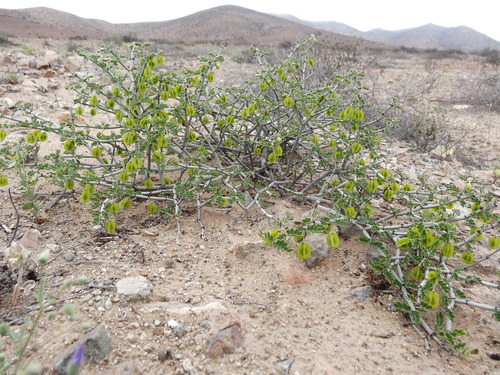
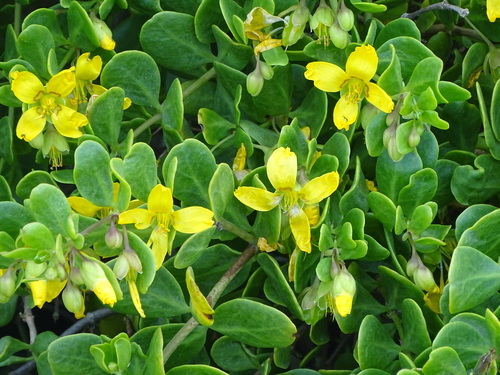
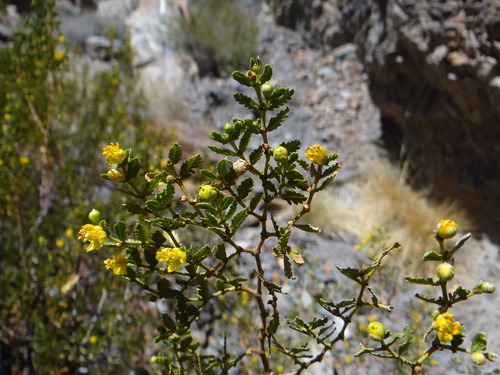
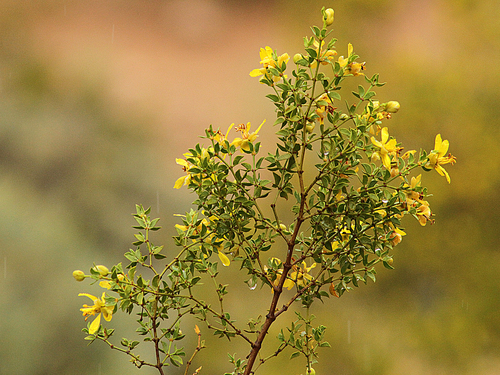
Larrea tridentata is an evergreen shrub that typically grows 1 to 3 meters (3 to 10 feet) tall, and rarely reaches 4 meters (13 feet) in height. Its light gray stems produce resinous, dark green leaves; each leaf consists of two opposite lanceolate leaflets joined at the base, with a deciduous awn between the leaflets. Individual leaflets measure 7 to 18 mm (1⁄4 to 11⁄16 in) long and 4 to 8.5 mm (5⁄32 to 11⁄32 in) wide. The flowers grow up to 25 mm (1 in) in diameter, and have five yellow petals. The fruit is a brown-burgundy, spherical, fuzzy capsule that splits into five separate carpels, each holding one seed. Galls can form on the plant from the activity of the creosote gall midge. The entire plant has a characteristic creosote odor, which gives the species its common name: creosote bush. In regions where it grows, this scent is often linked to the "smell of rain", because the scent of its resinous leaves becomes stronger when it rains.
Larrea tridentata is a prominent species in the Mojave, Sonoran, and Chihuahuan Deserts of western North America. Its range covers these deserts and adjacent regions in parts of the United States including southeastern California, Arizona, southern Nevada, southwestern Utah, New Mexico, and Texas, and in Mexico includes the states of Chihuahua, Sonora, Coahuila, Nuevo León, Zacatecas, Durango and San Luis Potosì. The species grows as far east as Zapata County, Texas, along the Rio Grande southeast of Laredo near the 99th meridian west.
Creosote bush is most common on well-drained soils of alluvial fans and flats. In parts of its range, it can cover large areas in nearly pure stands, though it usually grows alongside Ambrosia dumosa (burro bush or bur-sage). Chemicals from creosote bush roots have been found to inhibit the growth of burro bush roots, but as of 2013, much of this relationship remains unexplained. Creosote bush stands typically have an evenly spaced distribution of individual plants. Originally, researchers assumed creosote produced a water-soluble inhibitor that prevented other bushes from growing near mature, healthy individuals. It has since been shown that the root systems of mature creosote plants are simply so efficient at absorbing water that fallen seeds near a mature plant cannot collect enough water to germinate, effectively creating dead zones around every plant.
A number of animals feed on different parts of the creosote bush. Only jackrabbits eat creosote leaves among mammals, and only when no other food is available because the leaves are bitter; reptiles that eat creosote leaves include desert iguanas and chuckwallas. Desert woodrats and kangaroo rats eat creosote seeds. Twenty-two species of bees act as pollinators feeding on creosote flowers, and chuckwallas and desert iguanas also eat creosote flowers. Many other insect species also interact with creosote. Arabian camels, introduced to the region by the United States Camel Corps, readily eat creosote bush. It has been hypothesized that this interaction reestablishes a biological relationship that was broken when native North American camels went extinct in the Quaternary Extinction Event, making creosote bush an evolutionary anachronism.
When used as a herbal remedy and supplement, Larrea tridentata is often called chaparral; however, the species does not grow in the chaparral plant community that shares this name. The United States Food and Drug Administration has issued warnings about the health hazards of ingesting chaparral or using it as internal medicine, and discourages internal use of the plant. In 2005, Health Canada issued a warning to consumers advising them to avoid using the leaves of Larrea species due to the risk of liver and kidney damage. Cancer Research UK states: "We don't recommend that you take chaparral to treat or prevent any type of cancer."
Southwestern Native American groups held beliefs that this plant treated many illnesses, including sexually transmitted diseases, tuberculosis, chicken pox, dysmenorrhea, and snakebite. The Coahuilla Indians used the plant to treat intestinal complaints and tuberculosis. The Pima people drank a decoction of the leaves as an emetic, and applied boiled leaves as poultices to wounds or sores. Tohono O'odham Indians prepared the plant as medicine for stiff limbs, snake bites, and menstrual cramps. The shrub remains widely used as a herbal medicine in Mexico. For another use, the Tohono O'odham used reddish lac that exudes from the plant; after boiling, they used it as a mending glue for broken pottery.