About Larrea divaricata Cav.
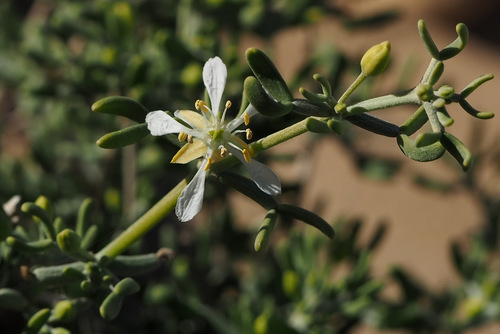
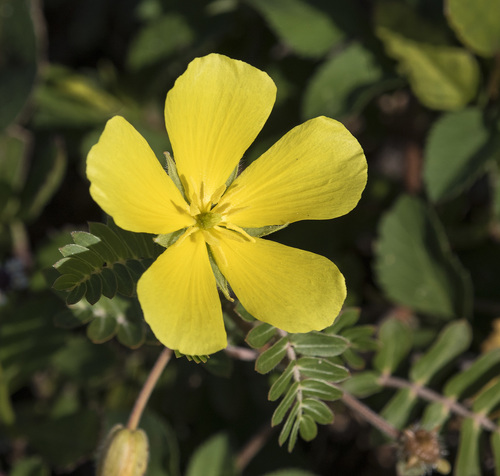
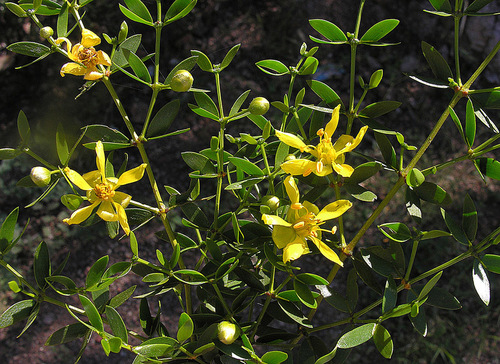
Larrea divaricata Cav. is a slow-growing shrub that reaches a maximum height of 3 meters (10 feet). It has cylindrical stems, and its small, dark green, elliptical leaves are resinous and grow in opposite pairs. Its yellow flowers have five petals, and bloom during October and November. Its fruits are dry capsules covered in greyish hairs that hold five seeds. Goats disperse this plant when they eat its leaves and seed capsules during the dry season, when very little grass grows in its native range. Larrea divaricata is endemic to southwestern South America, found across Bolivia, Peru, Chile, and Argentina, most commonly in Patagonia. It grows in open woodland, scrubland, and rough grassland, and is only native to South America. Its close relative, Larrea tridentata, grows in North America. The two species were confused with one another in the past, but were confirmed to be separate species in the 1940s. The resin of Larrea divaricata contains lignans, which are polyphenolic substances that may have therapeutic applications. The plant also contains guaiaretic acid and its derivatives, flavonoids, triterpenes, and other organic compounds. In Bolivia, an extract of Larrea divaricata has been used as an abortifacient. Because Larrea divaricata is suspected to be an adulterant in "chapparral" preparations, the herbal remedy made from Larrea tridentata, use of chapparral is not recommended during pregnancy and lactation. An aqueous extract of Larrea divaricata has been found to have antimicrobial properties against Helicobacter pylori, a Gram-negative stomach bacterium linked to gastritis, peptic ulcers, and stomach cancer.