About Larix occidentalis Nutt.
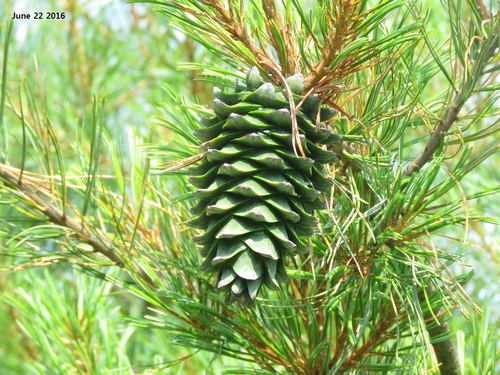
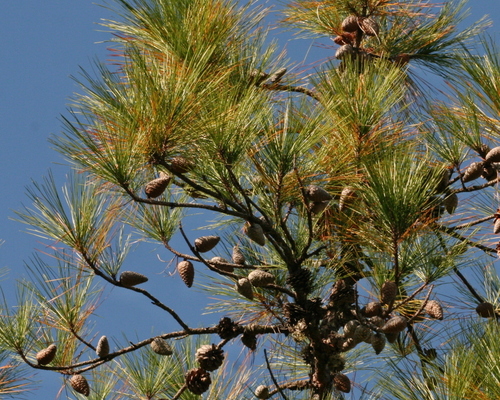
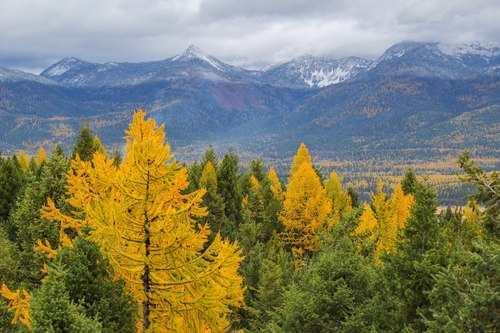
Larix occidentalis Nutt., commonly known as western larch, is a large deciduous conifer. Mature trees reach 30 to 60 meters (98 to 197 feet) in height, with trunks up to 1.5 m (4 ft 11 in) in diameter. Their bark ranges in color from orangish to purplish brown, and they have a narrow conic crown. Main branches grow level to upswept, while side branches often droop. Shoots are dimorphic, divided into two distinct forms: long shoots typically 10 to 50 centimeters (4 to 20 in) long that bear several buds, and short shoots only 1 to 2 millimeters (1⁄32 to 3⁄32 in) long that hold only a single bud. Its leaves are needle-like, light green, 2 to 5 cm (3⁄4 to 2 in) long, soft and very slender. They turn bright yellow in fall, then fall off to leave pale orange-brown shoots bare until the following spring. Seed cones are ovoid-cylindric, 2 to 5 cm (3⁄4 to 2 in) long, with 40 to 80 seed scales. Each scale bears an exserted 4 to 8 mm (3⁄16 to 5⁄16 in) bract. Immature cones are green to reddish purple; they turn brown when mature four to six months after pollination, and their scales open flat or reflexed to release seeds. Old cones commonly remain on the tree for many years, fading to dull gray-black. Individual western larches can live for centuries, even up to one thousand years. The largest known specimen is approximately 1,000 years old, 50 m (160 ft) tall, over 2 m (7 ft) in diameter, and has a 10 m (34 ft) crown; it grows at Seeley Lake, Montana. Western larch grows almost exclusively in the Columbia River drainage, from the east side of the Cascade Range to the west side of the Continental Divide. Its range extends from near Kamloops, British Columbia, south to Weiser, Idaho, and Central Oregon. It occurs in the Blue Mountains and other ranges in southeast British Columbia and northwest Montana, and is most commonly found on moist slopes up to 1,800 m (5,900 ft) above sea level. It can grow at elevations between 500 and 2,400 m (1,600 and 7,900 ft), is very cold tolerant, and can survive winter temperatures down to approximately −50 °C (−58 °F). It only grows on well-drained soils, and cannot thrive on waterlogged ground. Western larch grows faster than many tree species it associates with, which is a necessary adaptation because it is shade intolerant. Thanks to its thick bark, nonflammable foliage, and protective cones, the species is very fire resistant. In the late 20th century, after almost a century of wildfire suppression, larches at Seeley Lake and Glacier National Park were endangered by major fires fueled by accumulated fuel ladders; normally, smaller regular fires would have reduced this excess fuel. In more recent years, many smaller fires have been allowed to burn naturally. Grouse browse the leaves and buds of this tree. Its seeds are an important substitute winter food for some birds, most notably the pine siskin, and also including redpolls and white-winged crossbills. This use typically happens when other preferred conifer cone seeds are in short supply. Woodpeckers make nesting openings in older specimens affected by heart rot, and these openings are later used by various small animals. Indigenous peoples used the tree for multiple purposes: they applied resinous gum to injuries, chewed it to treat sore throats, and ate its cambium and sap. In particular, the Kutenai and Bitterroot Salish of Montana collected the tree's sap. Medicinal teas were made from the bark or foliage, and some Plateau Indian tribes drank an infusion made from young shoots to treat tuberculosis and laryngitis. The sweetish galactan found in the sap can be processed into baking powder and medicine. A tree extract is sold commercially as a health supplement. Its water-soluble arabinogalactan is used in food, medicine, ink, and paint. The wood is tough, durable, and flexible when cut into thin strips. It is highly valued for yacht building, as yacht construction requires knot-free wood that can only be obtained from old trees pruned when young to remove side branches. Small larch poles are widely used for rustic fencing. The wood is very popular as firewood in the Pacific Northwest, where it is often called "tamarack", even though it is a separate species from tamarack larch. It burns with a sweet fragrance and a distinctive popping noise. Western larch is also used to produce Venice turpentine.