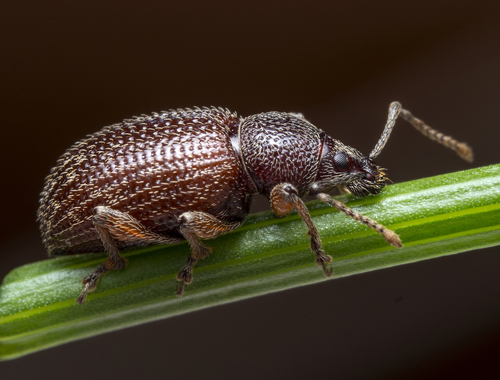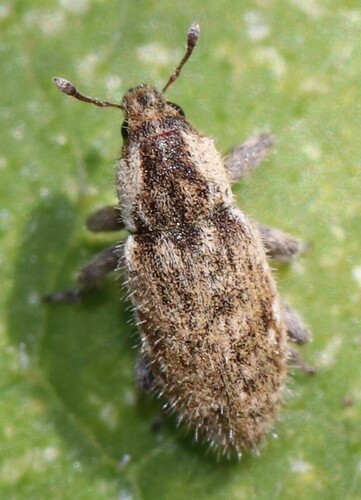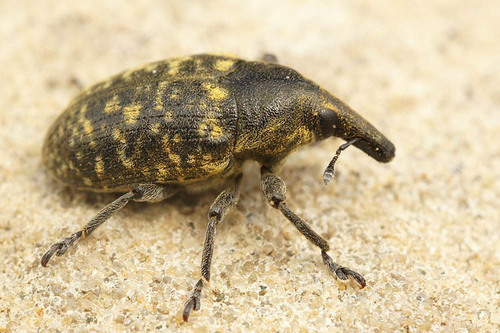
About Larinus turbinatus Gyllenhal, 1835
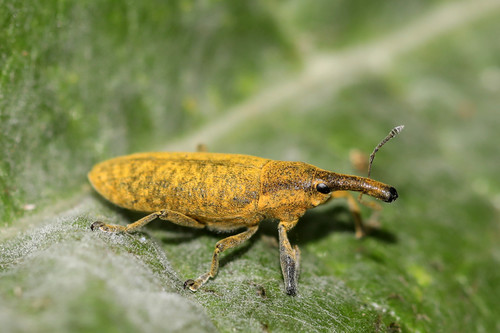
Larinus turbinatus can reach a body length of about 4.00–9.00 mm (0.157–0.354 in). These weevils have a robust, oval black body with many patches of gray setae, which appear yellowish due to a yellowish secretion and adhering pollen. Their antennae are short with conspicuous clubs. The head and rostrum of female Larinus turbinatus are blacker than those of males. The pronotum is transverse, rounded, strongly punctured, and has tapering lateral margins. The elytra are wider than the pronotum, have a rounded apex, are irregularly covered with hair, and are finely striate. The rostrum is robust, short, straight, and conically tapers to the apex, with a latero ventral ridge and a longitudinal groove. This species is similar in size to Larinus carlinae and can be confused with it. This species is native to the western Palaearctic, and is present in southern and central Europe (including Albania, Austria, Bosnia and Herzegovina, Bulgaria, Croatia, Czech Republic, France, Germany, Greece, Hungary, Italy, Republic of Moldova, Poland, Portugal, Romania, Slovakia, Slovenia, Spain, Switzerland, Ukraine and Yugoslavia), the Caucasus, western Russia, Asia Minor, Central Asia, Siberia and North Africa. It has been introduced to the United States. These warmth-loving weevils mainly occur on open, warm slopes, in grassland, wet meadows and pastures where thistles are present.