About Larinus sturnus (J.G.Schaller, 1783)
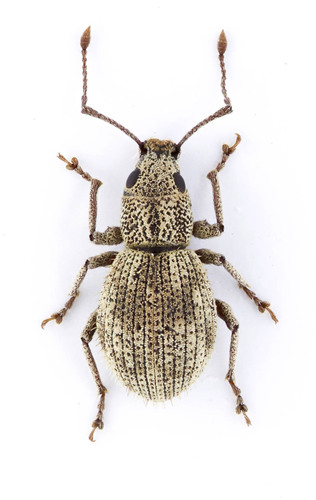
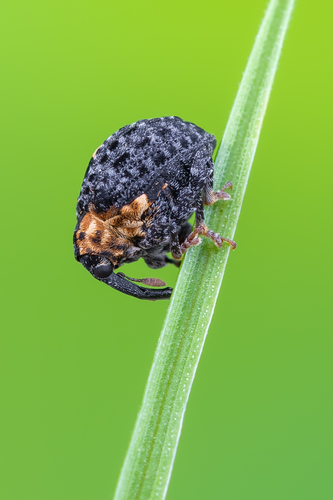
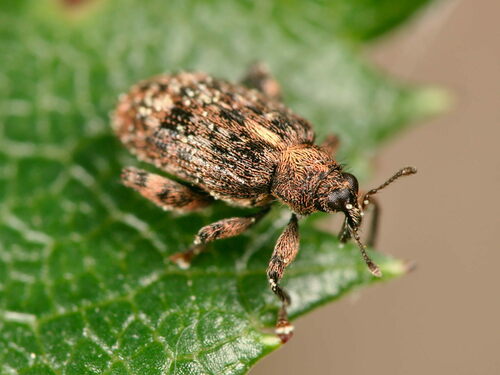
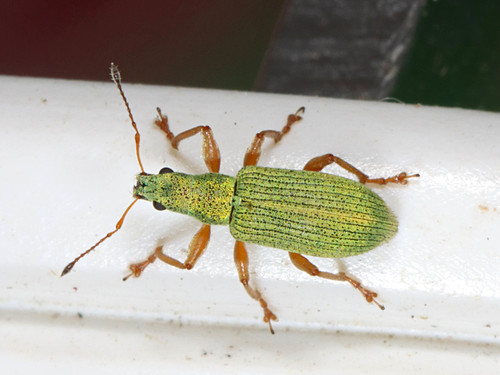
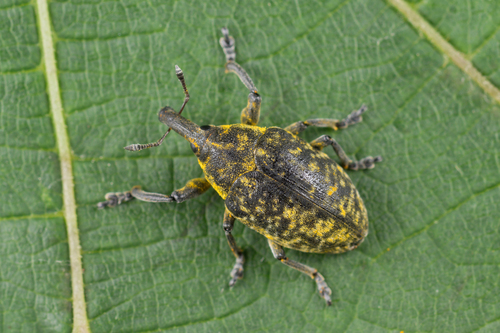
Larinus sturnus, first described by J.G.Schaller in 1783, has a body length of approximately 8–13 mm (0.31–0.51 in). These are relatively small weevils with a black, oval, punctuated body that is densely covered with yellow dust. They have several yellowish patches made of gray setae, which look yellowish due to a yellowish secretion and adhering pollen. The pronotum is one and a half times wider than it is long. Its oval elytra are wider than the pronotum, and there is a slight but noticeable indentation in front of the scutellum. Like other weevils, this species has the characteristic weevil rostrum: it is thick, long, and curved, and it is shorter in males and relatively longer in females. Its antennae are short, with clearly visible clubs. Larinus sturnus is similar in appearance and often confused with other species in the Larinus genus, including Larinus planus, Larinus jaceae, and Larinus turbinatus; unlike these similar species, Larinus sturnus is usually larger. This species is widespread across central and southern Europe, found in Albania, Austria, Bulgaria, Croatia, the Czech Republic, France, Germany, Greece, Hungary, Italy, Poland, Romania, Serbia, Slovakia, Slovenia, Spain, and Switzerland. It is absent only from the British Isles and northern Scandinavia. It is also present in the Mediterranean region including North Africa (Algeria and Morocco), the Near and Middle East (Iran), and Central Asia (Turkestan). Its range extends further to southern Siberia as well as Central Asia. These weevils live in meadows, pastures, roadsides, forest and shrub edges, clearings, and dry slopes.