About Lapageria rosea Ruiz & Pav.
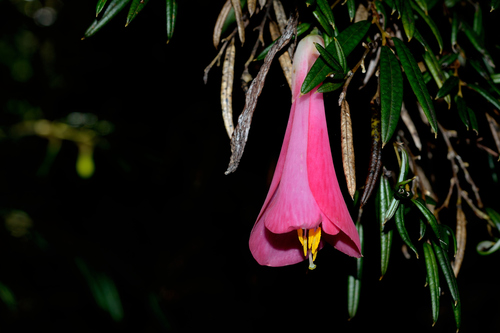
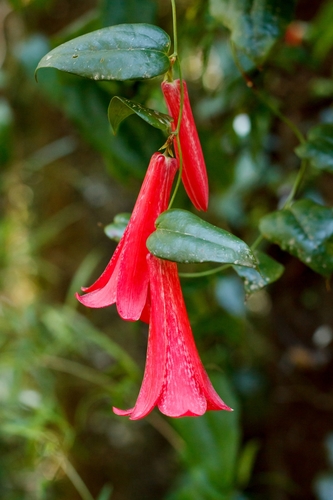
Lapageria rosea Ruiz & Pav. is an evergreen climbing plant that can grow over 10 metres (33 ft) tall, climbing up shrubs and trees. Its evergreen leaves are arranged alternately, have a leathery texture, a lanceolate shape, and three to seven distinct parallel veins. The twining vines of this species twine counterclockwise when growing in the Southern hemisphere, and clockwise when grown in the Northern hemisphere; this pattern is likely caused by the sun's apparent motion across the sky. Its flowers have six thick, waxy tepals that are most often red, with white spots. Flowers are most commonly produced in late summer and fall, though they can appear at other times of year. The fruit is an elongated berry with tough outer skin, containing many small seeds that are about the size of tomato seeds. Each seed is covered by an edible fleshy aril. In the wild, this plant is pollinated by hummingbirds. Lapageria rosea is related to Philesia magellanica (synonym P. buxifolia), another species from Valdivian flora. The two have similar flowers, but Philesia magellanica is shrubby rather than climbing. ×Philageria veitchii is a hybrid between L. rosea and P. magellanica, and it looks much more like L. rosea than its other parent. Pollen is distributed by birds (mostly hummingbirds), as well as by insects and other animals. The shape of the flower matches the syndrome of specialization for hummingbird pollination. Recorded insect pollinators include Bombus dahlbomii, a species native to southern South America, plus Bombus terrestris and Bombus ruderatus, both non-native invasive species in southern South America. This plant was introduced to Britain by collector William Lobb during his 1845–1848 plant collecting expedition to the Valdivian temperate rain forests, and it was already growing at Kew Gardens by 1847. When grown in cultivation, it needs a shaded, sheltered location with acidic or neutral soil. It can survive winter temperatures down to −5 °C (23 °F), so in the United Kingdom it can be grown outdoors in mild or coastal areas. It has been awarded the Royal Horticultural Society's Award of Garden Merit. This species is considered highly valued for the beauty of its flowers and for its fruits. After its introduction to Europe in the late 1840s, naturalist Claudio Gay noted in 1853 that it could be expected to soon become one of the most popular plants sought after by horticulturists and garden enthusiasts. Hand-colored lithographs of the species were published throughout the second half of the 19th century in a range of scientific and horticultural journals, including Flore des Serres et des Jardins de l'Europe (1849), Annales de la Société royale d'Agriculture et de Botanique de Gand – Journal d'horticulture (1849), Maandschrift voor tuinbouw (c. 1852), La Belgique horticole, journal des jardins et des vergers (1853), and Revue de l'horticulture belge et étrangère (1882). Its primary value is as an ornamental plant. In 2012, Lapageria rosea var. albiflora also received the Award of Garden Merit from the United Kingdom's Royal Horticultural Society. In addition to its ornamental use, the fruits of L. rosea are edible; they have been described as sweet, very pleasant tasting, and highly refreshing. This species also has other traditional uses: in phytotherapy and herbal medicine, its roots are used to treat conditions including gout, rheumatism, and certain sexually transmitted infections. Its stems are used in basketry, for example to make chaihues, a type of basket that functions as a strainer.