About Laothoe populi Linnaeus, 1758
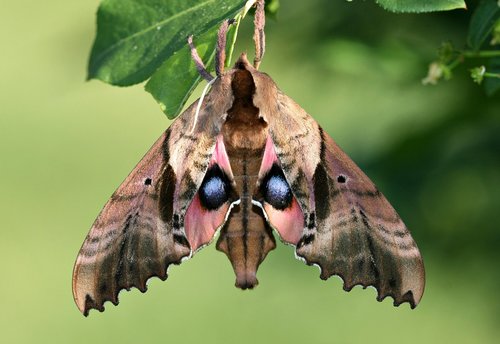
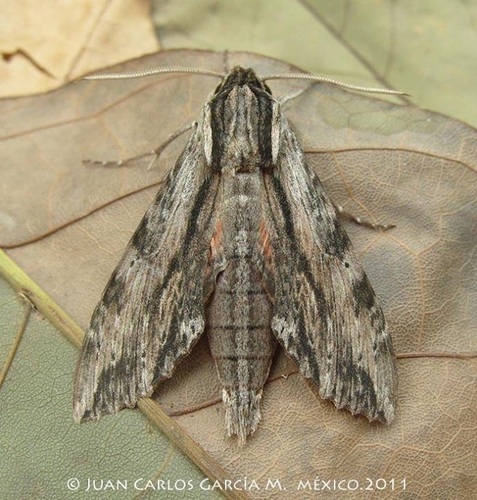
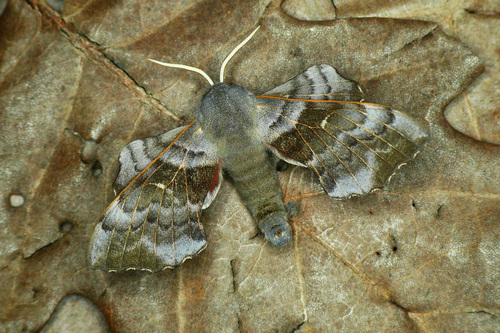
Laothoe populi, the poplar hawkmoth, is a large moth with a 70–100 mm wingspan, with an unusual appearance from its resting posture of holding hindwings further forward, still half-hidden by forewings. The species lacks a frenulum joining its wings, and looks like a cluster of dead poplar leaves, its main host. When disturbed, it suddenly reveals a bright orange-red basal patch on the hindwing, likely used as a distraction or startle display. The wings are grey marked with darker grey fascia; the greys are sometimes replaced by buffish tones, a form more common in females than males. There is a white spot at the distal edge of the cell on the forewings. Gynandromorphs, individuals half female and half male, are common. Poplar hawkmoths can produce hybrids when mated with eyed hawkmoths, Smerinthus ocellatus, and these hybrids have eyes on the hindwings. The species produces one or two broods each year, and adults can be seen from May to August. Females lay large, spherical, pale green, glossy eggs, which are placed singly or in pairs on the underside of host plant leaves. A single female lays around 50 to 200 eggs. When first hatched, the larva, called a hornworm, is pale green with small yellow tubercles and a cream-coloured tail horn. As it matures, it develops yellow diagonal stripes on its sides, and pink spiracles. Larvae feeding on willows may become heavily spotted with red. Other larvae are more bluish white with cream stripes and tubercles. They have stout bodies and grow to 65–85 mm (2.6–3.3 in) long. Larvae feed on tree leaves including poplar, willow and aspen. The species overwinters as a pupa. Larvae pupate in an earthen cell 2–3 cm (0.79–1.18 in) below the soil surface, near the host plant. The pupa has a short cremaster. Adults live for a few weeks, do not feed, and rely on fat stored during the larval stage. Though they emerge late at night or early in the morning, they do not start flying until the second night after emergence, and are strongly attracted to light.