About Lantana montevidensis (Spreng.) Briq.
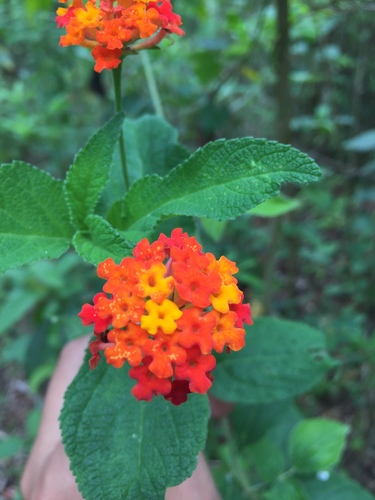
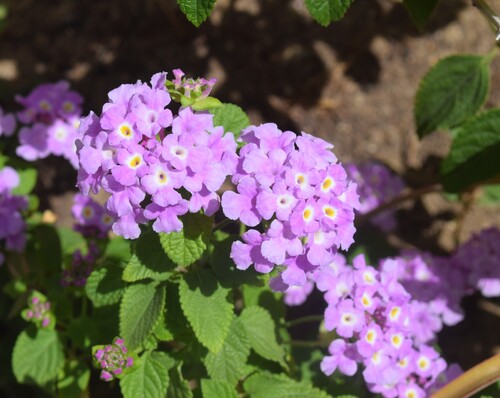
Lantana montevidensis is a small, strongly scented flowering trailing or rambling shrub or subshrub with oval green leaves that grows into a mat. When given support it takes a climbing vine form, when grown on an edge it takes a trailing form, and when grown on flat ground it grows as a groundcover. This plant has thin, creeping or drooping, hairy stems and branches that reach up to 1 meter long, and sometimes up to 4 meters under favorable conditions. Stems and branches are 1–2 mm thick, usually quadrangular in cross-section when young, and unlike Lantana camara, they do not have prickles. Nodes may produce roots when they come into contact with soil. The bright green leaves are ovate to oblong-ovate (egg-shaped), sometimes narrowly ovate, and roughly 2.5 cm long. They are roughly serrated, have short petioles, and are oppositely arranged on the stem in opposite pairs, with successive pairs growing at right angles to each other. The upper surface of the leaf is coarse (scabrous), while the lower surface is softly hairy (pubescent). This species is native to Uruguay, northeastern and northwestern Argentina, Bolivia, Paraguay, and southern Brazil. It is now found nearly worldwide as an introduced garden and landscape plant, and has become naturalized in New Zealand, Hawaii, New Caledonia, and the southern United States (specifically California, Texas, Louisiana, Alabama, Georgia, and Florida). In some regions, including parts of Australia and Hawaii, it is classified as a noxious weed and an invasive species. It typically grows in tropical and subtropical environments, and occurs sporadically in temperate and semi-arid areas. In Australia, it was first introduced as an ornamental plant in 1851, and began escaping from cultivation in 1871. Today it is found in well-drained wilderness on alluvial soil, eucalyptus forest on loamy soil, on sandstone rocks, disturbed areas near mangroves, and alongside roadsides and river banks. Its seeds are widely dispersed by fruit-eating animals and birds, by water flowing over soil during heavy rain, and by mud clinging to animal hooves and human footwear. It can also spread vegetatively through layering. Lantana montevidensis is cultivated as an ornamental plant, valued for its abundant colorful lavender to purple flowers. It is grown as a drought-tolerant groundcover, woody vine, or trailing plant for both containers and in-ground planting. In subtropical climates, it produces flowers for most of the year, and yellow-flowering and variegated-leaved cultivars are also available. It is a hardy, long-lived shrub that can survive extended periods of drought, and can grow and reproduce in both full sun and shaded conditions. This plant is toxic to livestock.