About Lantana camara L.
Lantana camara L. is a perennial shrub that can grow erect, sprawling, or scandent. It typically reaches around 2 meters (6 1/2 feet) tall and forms dense thickets across a variety of environments. In favorable conditions, it can scramble up into trees and reach up to 6 meters (20 feet) tall.
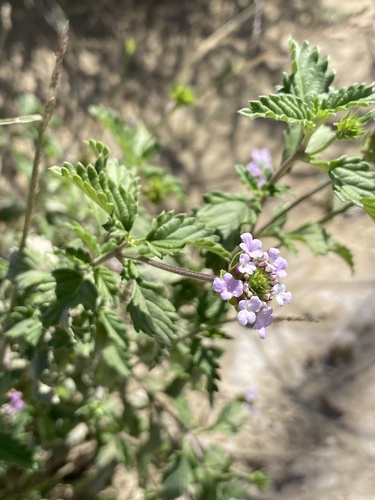
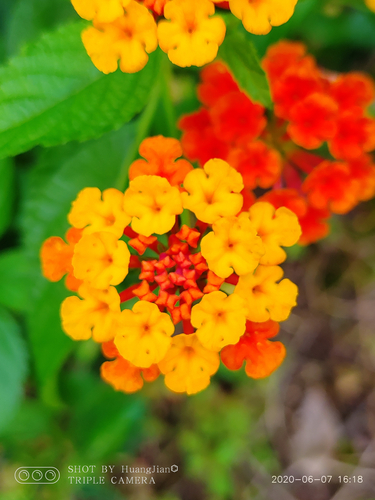
Its leaves are broadly ovate, opposite, and simple, and release a strong odor when crushed. The species produces small tubular flowers, each with four petals, arranged in clusters at the terminal ends of stems. Flowers come in many colors, including red, yellow, white, pink, and orange, with color varying based on position in the inflorescence, age, and maturity. The flowers have a tutti frutti scent with a peppery undertone. After pollination, flower color changes, most commonly from yellow to orange, pink, or red. This change is thought to act as a signal to pollinators, indicating that flowers with the original color hold a reward and are sexually viable, which increases pollination efficiency. In frost-free climates, this plant can bloom year-round, especially when soil is moist. Australia has five major recognized flower color varieties: Pink: buds are pink; middle ring flowers open yellow with pale yellow petals; outer ring flowers open orange with pale or dark pink petals. White: buds are cream colored; middle ring flowers open yellow with light yellow petals; outer ring flowers open orange or yellow with lilac petals. Pink-edged Red: buds are pink to reddish pink; middle ring flowers open orange with light yellow to orange petals; outer ring flowers open orange with two pink to red petals. Red: buds are blood red; middle ring flowers open yellow with yellow petals; outer ring flowers have a red throat with red petals. Orange: buds are orange; middle ring flowers open yellow to orange with yellow petals; outer ring flowers open orange with orange petals.
The fruit is a berry-like drupe that changes from green to dark purple when mature. Green unripe fruits are inedible to both humans and animals. Ingesting unripe fruits can cause serious damage to the digestive tract, due to dense patches of hard spikes on their rind. Lantana camara reproduces both by seed and vegetatively; a single plant can produce up to 12,000 fruits.
The native range of Lantana camara is Central and South America, but it has become naturalized in around 60 tropical and subtropical countries worldwide. It is commonly found in east and southern Africa, where it grows at altitudes below 2,000 meters (6,600 feet), and often invades previously disturbed areas such as logged forests and land cleared for agriculture. It has also spread across other parts of Africa, Southern Europe (including Spain and Portugal), the Middle East, India, tropical Asia, Australia, New Zealand, the United States, and many Atlantic, Pacific, and Indian Ocean islands. It became a significant weed in Sri Lanka after escaping from the Royal Botanical Gardens in 1926. Lantanas were introduced to Australia as an ornamental garden plant in 1841, and they spread, escaped cultivation, and became established in the wild within 20 years. The British brought Lantana camara to India around 200 years ago, after which it spread and became invasive there. A 2023 national monitoring effort found that Lantana camara has invaded around 50% of natural areas in India. It was introduced to the Philippines from Hawaii as part of an exchange program between the United States and the Philippines, escaped cultivation, and has since become naturalized across the islands. It has also been introduced across the entire southern United States, from California to North Carolina, and is considered hardy in U.S. Department of Agriculture zones 10 and 11.
The range of Lantana camara is still increasing: it has invaded many islands where it was not present in 1974, including the Galapagos Islands, Saipan, and the Solomon Islands. There is also evidence that it is still expanding its range in areas where it has been established for many years, such as East Africa, Australia, and New Zealand. Its ability to rapidly colonize disturbed land has allowed it to proliferate in countries where logging, agricultural clearance, and forest fires are common. In contrast, its distribution is limited in countries with large areas of intact primary forest.
This species occurs in a wide variety of environments, including agricultural areas, forest margins and gaps, riparian zones, grasslands, secondary forest, and beach fronts. It is rarely found in natural or semi-natural forest areas, because it cannot tolerate shade and cannot compete with taller trees, so it instead grows along forest edges. Lantana camara can survive in a broad range of climatic conditions, including drought, different soil types, heat, humidity, and salt. It is also relatively fire tolerant, and can quickly establish itself in recently burned forest areas.
In terms of ecology, birds and other animals eat its seeds, helping spread them over large distances. Lantana camara is known to be toxic to livestock including cattle, sheep, horses, dogs, and goats. The active compounds that cause toxicity in grazing animals are pentacyclic triterpenoids called lantadenes, which cause liver damage and photosensitivity. This species also excretes allelopathic chemicals that reduce the growth of surrounding plants by inhibiting germination and root elongation.
Toxicity to humans remains undetermined. Several studies suggest that ingesting berries can be toxic to humans, such as a study by O. P. Sharma that states "Green unripe fruits of the plant are toxic to humans". North Carolina State University's Extension Gardener website notes that ingesting the flowers, fruits, and leaves can cause vomiting, diarrhea, difficulty breathing, and liver failure, while contact with the leaves can cause contact dermatitis. A U.S. Department of the Army field guide states the plant can even be fatal. Contrarily, some studies have claimed that this species poses no risk to humans when eaten, and is actually edible when ripe.
Lantana camara stalks have been used to construct furniture such as chairs and tables. Historically, its main uses have been medicinal and ornamental. Studies conducted in India have found that Lantana leaves have antimicrobial, fungicidal, and insecticidal properties. It has also been used in traditional herbal medicine to treat a range of ailments, including cancer, skin itches, leprosy, chicken pox, measles, asthma, and ulcers. Lantana camara extract has been shown to reduce gastric ulcer development in rats.