About Lanius tigrinus Drapiez, 1828
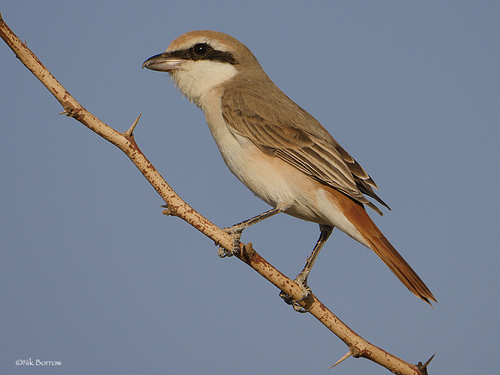
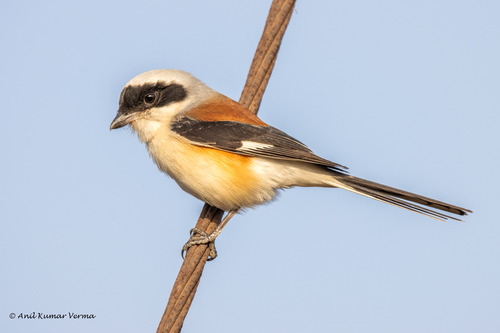
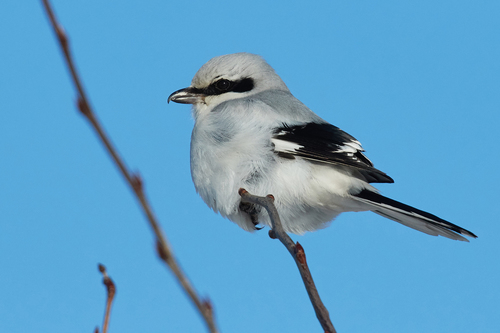
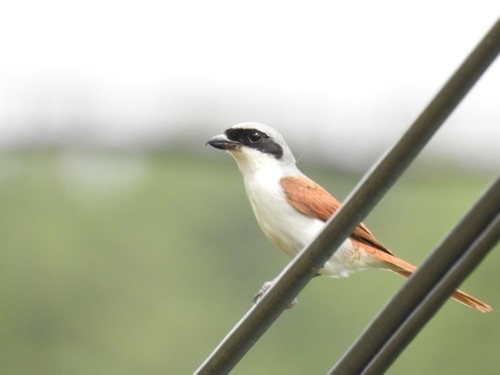
Lanius tigrinus Drapiez, 1828 is a fairly small, stocky shrike that measures 17–19 cm in total length. Males weigh 27 to 29 grams, with a wing length of 77.8 to 83.9 mm, a tail length of 66.9 to 75.0 mm, and a bill length of 14.1 to 15.9 mm. Females are larger, weighing 29 to 37 grams, with a wing length of 79.5 to 85.3 mm, a tail length of 66.3 to 79.1 mm, and a bill length of 14.8 to 16.7 mm. This species has a thick blue-black bill with a black tip, and grey-black legs. Adult males have reddish-brown back, rump, and shoulders marked with blackish bars that form a tiger-like pattern. They have a black forehead and facial mask, with a grey crown and nape. Their wings and tail are brown, and their underparts are white, sometimes with faint barring on the flanks. Females are duller and browner than males, with a less extensive black mask, less grey coloration on the head, a narrow white stripe above the eye, and a pale patch between the bill and eye. Their flanks are buff-white with distinct black barring. Juvenile birds have dark scale-like markings across the head, back, and underparts, and lack the grey and black head markings of adults. Juveniles have a pale base to the bill, and a pale ring around the eye that makes the eye appear large. This shrike breeds in temperate eastern Asia, where it inhabits deciduous or mixed woodland, forest edges, and farmland with scattered trees. It is restricted to lowland areas: it occurs mainly below 150 metres in Russia, below 800 metres in Japan, and below 900 metres in China. Its breeding range covers Ussuriland in the Russian Far East north to around 44°N, central and eastern China, Korea, and northern and central parts of the Japanese island of Honshū. It is a migratory species: it migrates south in August and September, and returns to its breeding grounds in May and June. It winters in tropical and subtropical Southeast Asia at elevations below 1,000 metres above sea level. Its non-breeding range extends from southeastern China south through eastern Burma, Thailand, Laos, and Vietnam to Malaysia and Indonesia, where a few individuals reach as far south as Java and Bali, and as far east as Sulawesi. During winter, it occupies forest clearings, forest edges, cultivated land, mangroves, and gardens. Vagrant individuals have been recorded in Hong Kong and the Philippines. In Australia, a dead individual that may have arrived via ship was once found near Fremantle, and one individual was observed on Christmas Island in April 2008. The species has a wide distribution and a fairly large population, so BirdLife International classifies it as least concern, meaning it is not considered threatened. However, its population has declined recently in Japan and Russia. In Japan, it is now uncommon and restricted to local areas, though it was formerly common and even occurred in the suburbs of Tokyo. The breeding season of Lanius tigrinus runs from May to July. Breeding pairs form during northward migration or shortly after arrival on breeding grounds, and pairs are monogamous. During courtship, males perch next to females, bow their body up and down, and move their head from side to side while uttering a soft subsong, which is a more subdued version of the species' normal song. Males also perform a fast display flight while calling. Both sexes work together to build a cup-shaped nest, which is usually placed 1.5 to 5 metres above ground on a branch of a deciduous tree, though it is sometimes built low among bushes. The nest is constructed from stems, twigs, roots, and other vegetation, and lined with grasses. Females lay three to six eggs per clutch, with five being the most common number. Eggs vary in color, with dark markings on a whitish, pinkish, or blue-green base background, and measure 21.2-24.1 mm by 15.3-17.8 mm. The female incubates the eggs for 14 to 16 days. Young birds fledge around two weeks after hatching, and remain close to the nest for an additional two weeks. Usually only one clutch is laid per breeding season, but a second clutch will be laid if the first clutch is lost. Many eggs are lost due to strong winds and predation by common magpies.