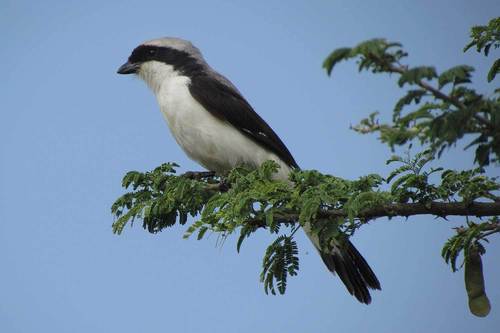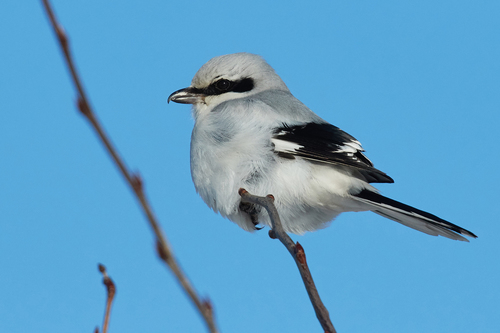
About Lanius tephronotus (Vigors, 1831)
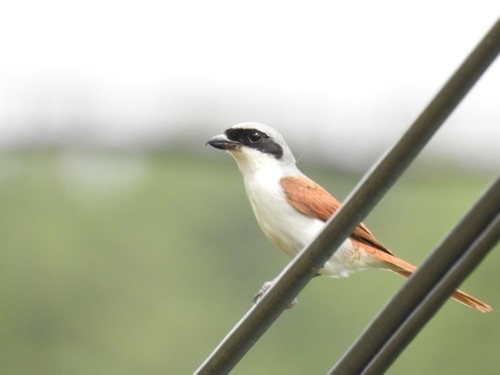
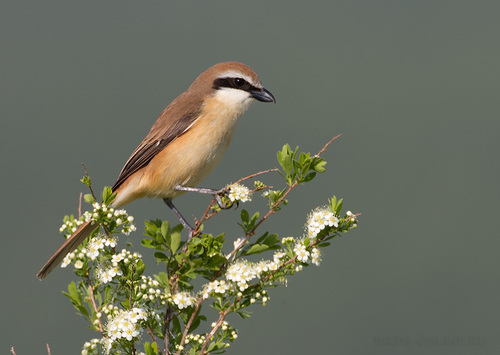
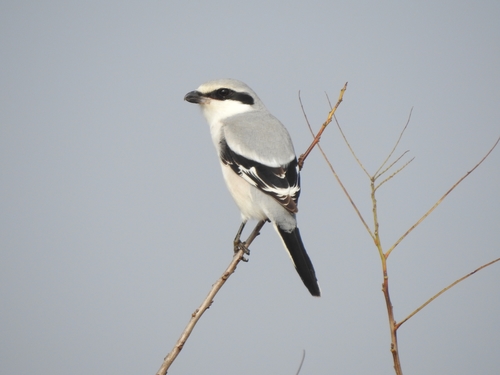
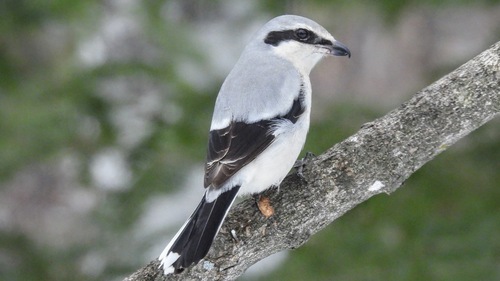
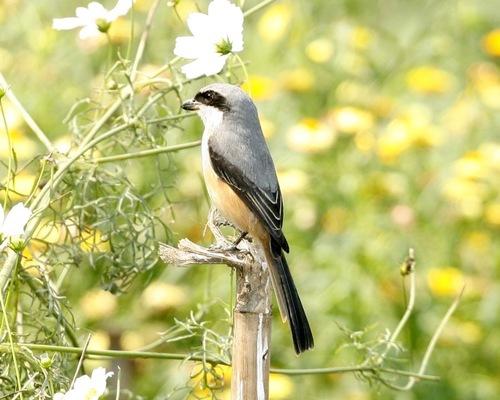
This species, commonly called the grey-backed shrike, measures 21–25 cm in length and weighs 39–54 g. It is a shrike with a long tail. The nominate subspecies has a black band on the lowest part of the forehead, just above the base of the bill, and a black facial mask that runs through the lores and eye to the rear of the ear-coverts. From the crown to the nape, and across most of the upperparts, plumage is dark grey, with a small rufous patch on the rump. The upperwing is black, with most wing-coverts, secondaries, and tertials fringed pale rufous to whitish; a tiny white patch at the base of the primaries is sometimes present, but is often lacking. The tail is chestnut-brown with buffish tips, and the outermost pair of tail feathers is light brown. The throat and undertail are brownish-grey. The iris is dark brown; the bill is black or dark green; the legs are dull black or dark green. The sexes are very similar in appearance. Juveniles are browner on the upperparts than adults, have a less prominent brown facial mask instead of the black mask seen in adults, have a horn-colored lower mandible, fine barring on the crown, and heavy dark brownish barring across the upperparts and most of the underparts. Subspecies lahulensis is smaller than the nominate race, has a weaker bill, is much paler overall, with brownish-grey upperparts, rufous lower back and rump. Its white primary patch is usually slightly larger and more visible, and the tail is sometimes blackish rather than brown. Its calls are rough and breathing-like. Territorial calls are harsh, described as zzert-zzert..., tchert-tchert... or tzert-tzert...; the vocal repertoire also includes a repeated ktcht-ktcht-ktcht, given at dusk or as an alarm call. The breeding song is subdued and musical, and includes mimicry of other bird calls that lasts for several minutes. Its voice appears similar to that of L. schach. The grey-backed shrike has two recognized subspecies. L. t. lahulensis breeds from north Kashmir east to central India (Uttar Pradesh) and southwest China. The breeding range of the nominate subspecies L. t. tephronotus extends from Nepal east to northeast India (Arunachal Pradesh), and into central and southern China (from southern Gansu, Ningxia and eastern Shanxi south to southeast Qinghai, southern and eastern Xizang, southeast Yunnan and central Guizhou). In the non-breeding season, the nominate subspecies ranges south to Bangladesh, Myanmar, Thailand and Indochina. This shrike breeds at high elevations in forest clearings, plateau plains and mountain meadows dotted with small trees or fairly large bushes, occurring up to at least 4500 m in Nepal, where it becomes common above 2700 m, and in Yunnan, southern China. After breeding, individuals in Sichuan, south China occupy either young open coniferous stands with bush-dominated forest clearings, or higher elevation pastures; at lower altitudes, it occurs in large agricultural valleys close to human settlements. On non-breeding grounds in valleys and plains, it can be found in a wide range of habitats including gardens and abandoned cultivation. Its diet consists mostly of insects such as moths, crickets and grasshoppers (Orthoptera), beetles (Coleoptera) and caterpillars; it may also consume small vertebrates including lizards, frogs, birds and small rodents. Grey-backed shrikes are primarily sit-and-wait predators, often perching at the top of tall grasses, bushes, or trees while searching for moving prey, so accessible high-quality perch sites in foraging areas are important for the species. They catch prey mostly on the ground, but will occasionally hawk for insects in the air. During the breeding season, they hunt only within 150 meters of the nest. Like other shrikes, they prefer to impale prey and maintain food larders.